
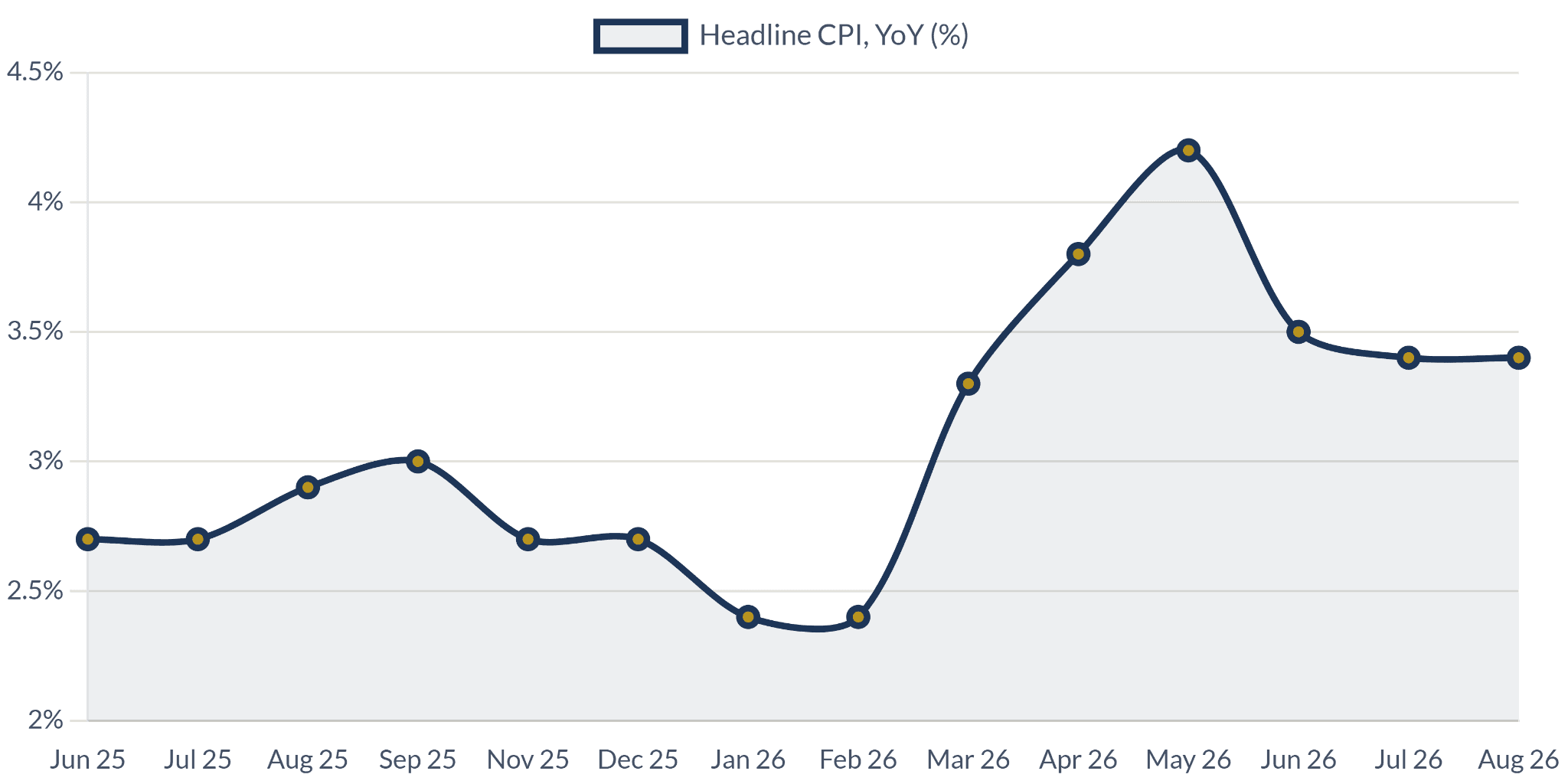
The Bureau of Labor Statistics reported headline CPI up 0.4% for August, taking the annual rate to 3.4%, exactly matching the Dow Jones consensus.
On a standalone basis that would read as a non event. The trouble sits one line down. Core CPI, which strips out food and energy, rose 0.3% for the month against a consensus closer to 0.2%. Bloomberg's survey of 73 economists found only nine had forecast a print that large.
The annual core rate held at 2.4%, technically the smallest year over year core reading since the current inflation cycle began in 2021, a function of favourable base effects rather than a cooling trend in the monthly data.
Gasoline did a lot of the work on the headline number, up 3.9% for the month and responsible for more than a third of the total increase.
Shelter costs, which had moderated over the prior two months, picked back up with a 0.3% rise, the fastest in three months.
Transportation services climbed 0.5%, used vehicles rose 0.4%, and new vehicle prices added 0.3%, a broad based set of gains across categories rather than a single outlier.
A 25.4% year over year jump in computer software and accessories, the largest on record for that category, was the clearest fingerprint of AI related capital spending showing up in consumer facing prices.
Table of contents
- US CPI and PPI: The Underlying Heat
- Oil, the Iran War, and the Pass-Through Channel
- FOMC Repricing: From Will They Cut, to Will They Hike
- The Takeaway: Portfolio Implications for Investors
US CPI, year over year
Headline inflation has accelerated since the February 2026 low and has held near 3.4% for three straight months.
The August report followed a hotter than expected Producer Price Index a day earlier. Wholesale prices rose 0.4% for the month, in line with forecasts, but the annual PPI rate of 5.4% came in 0.1 percentage point above estimate and remains well above the Fed's 2% target.
Core PPI eased slightly to 0.2%, but the headline number, driven heavily by energy costs, was enough to unsettle a market already nervous about what CPI would show a day later.
Oil, the Iran war, and the pass through channel
The inflation story this month cannot be separated from the Middle East. Brent crude broke back above $100 a barrel on September 9, its first close above that level since July, after US Central Command said it had destroyed five Islamic Revolutionary Guard Corps oil tankers and Houthi forces stepped up attacks on Saudi Arabia.
The move built through the week: Brent was trading near $93 a barrel as recently as September 2, and by Thursday, September 10, US crude had jumped more than 6% intraday to briefly top $102, its sharpest single session move in months.
Prices eased somewhat on Friday as the CPI print offered some relief, but the structural backdrop, a war that has intermittently disrupted Middle East tanker traffic since February, remains firmly in place.
Energy is the most direct pass through into headline inflation, and it is precisely the channel a central bank finds hardest to look past when the labour market is still resilient. August payrolls of 162,000 and a steady 4.1% unemployment rate gave the Fed little cover to treat this month's inflation surprise as noise.
FOMC repricing: from will they cut, to will they hike
The most consequential shift this month has not been in the data itself but in how markets read Fed Chair Kevin Warsh.
As recently as August 27, CME's FedWatch tool put the odds of a 25 basis point hike at the September 15 to 16 meeting at just 35%, with most desks still debating the pace of cuts. Warsh's remarks at the Jackson Hole symposium on August 28 changed that calculus almost overnight, with hike odds nearly doubling to 60% by the following Monday.
The July meeting minutes, which showed three policymakers had already dissented in favour of a hike, added to the sense that the committee's centre of gravity had moved. By Thursday, September 10, with oil surging and PPI running hot, priced odds had climbed further to roughly 70%. Friday's CPI print, in line on the headline but firm on core, pushed CME FedWatch pricing to close to 90% for a hike next week.
It is worth being precise about what this would mean.
The Fed's target range has sat at 3.50% to 3.75% since July. A hike would be the first increase in the cycle since the current tightening regime began, a genuine regime change for a committee that spent most of 2025 debating how many cuts to deliver, not whether to reverse course entirely.
Prediction markets on Polymarket separately price a 67% to 78% probability of at least one hike somewhere in the 2026 calendar, with September and the December 8 to 9 meeting seen as the two live dates.
The takeaway
August's CPI report was in line on the headline and uncomfortably firm underneath, and it arrived alongside an oil shock that has pushed Brent back above $100 a barrel for the first time since July. Together, those two forces have taken the market's implied odds of a Fed rate hike on September 16 from roughly a coin flip in late August to close to 90% today.
- Consider a modest commodity or energy tilt within UCITS allocations as a partial hedge against both oil driven inflation and rupee weakness.
- Stagger lump sums around this event window rather than concentrating them into a single date.

