


When Indians look beyond the US, Ireland almost always makes the shortlist. It is the home of UCITS ETFs, funds designed for international investors, with cleaner dividend treatment and no US estate tax.
Add to that globally known companies like CRH, Kerry, and Ryanair, and Ireland becomes a natural destination for global allocations.
Most Indians only get bits and pieces. Some hear “just buy the ADR in New York,” others “look at the London listings,” and some push UCITS without explaining the tax side.
This blog puts it all together: the ways Indians can invest in Ireland, the taxes and costs that apply, and which route might fit your portfolio best.
Table of contents
- Can Indians invest in Irish stocks directly?
- US-listed Irish companies and ADRs
- LSE-listed Irish stocks
- UCITS ETFs (Ireland-domiciled)
- Taxation and costs for Indian investors
- Platforms that enable access
- Conclusion
Can Indians invest in Irish stocks directly?
The short answer is no. Indian residents cannot open a direct trading account with an Irish broker to buy shares on Euronext Dublin (Ireland’s stock market).
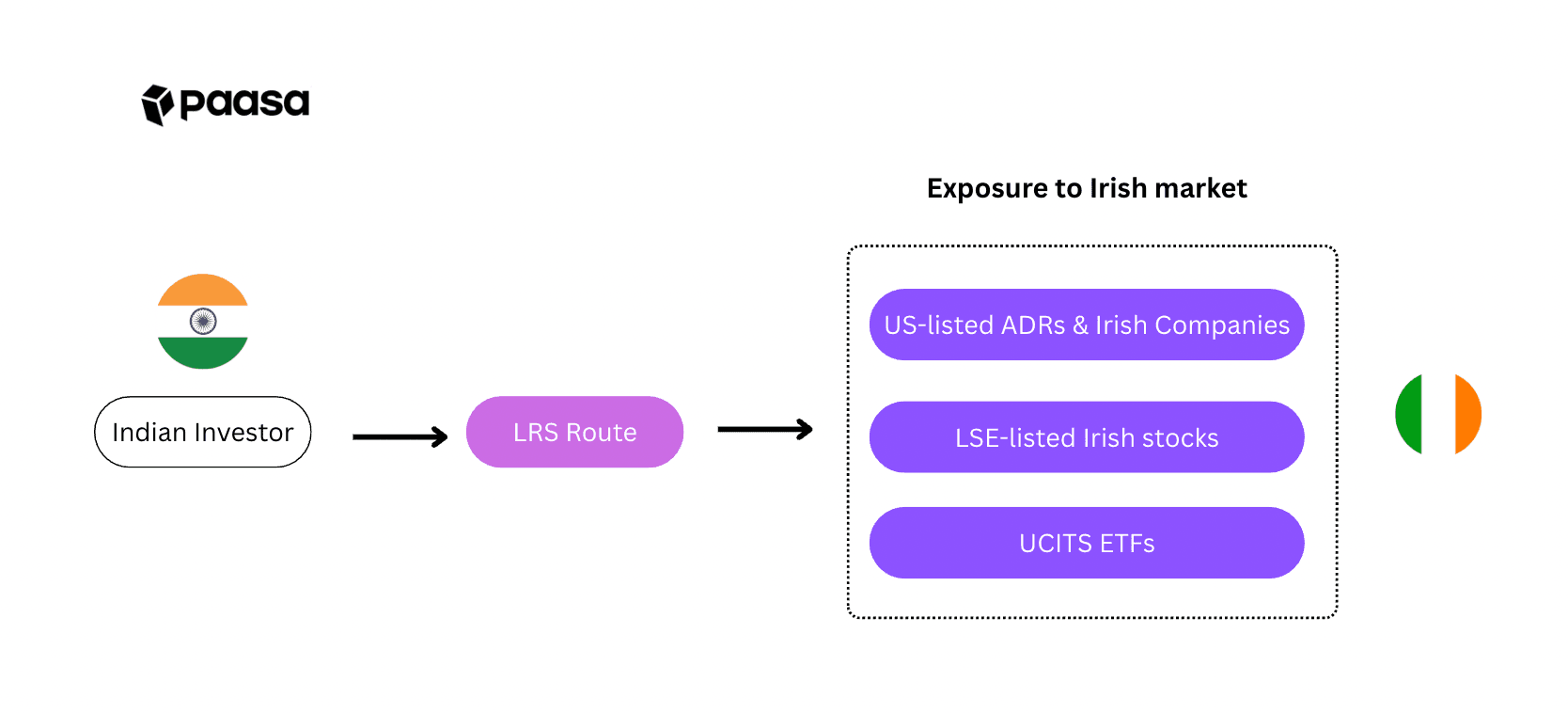
Instead, access happens through international routes:
- US-listed Irish companies or ADRs (e.g., CRH, Flutter, Ryanair ADR).
- London Stock Exchange (LSE) listings of Irish companies (e.g., Kerry).
- Ireland-domiciled UCITS ETFs that trade on European exchanges like LSE or Xetra (e.g., CSPX, VWCE, IWDA).
For Indian investors, all three routes are fully legal, practical, and accessible through global platforms like Paasa.
Important to know:
- All overseas investments by resident Indians, whether in US stocks, UK shares, or Irish UCITS ETFs, must be made under the RBI’s Liberalised Remittance Scheme (LRS).
- The limit is USD 250,000 per person per financial year.
- Above ₹10 lakh, banks deduct TCS (Tax Collected at Source) on remittances.
- All foreign assets must be reported in your Indian Income Tax Return (ITR).
US-listed Irish companies and ADRs
American Depositary Receipts (ADRs) are certificates issued by US banks that represent shares of foreign companies. They trade on US exchanges in USD, and their price is designed to mirror the underlying share.
Irish multinationals have tapped US markets in two ways:
- Direct US primary listings: companies like CRH plc (NYSE: CRH) and Flutter Entertainment (NYSE: FLUT) have shifted their main trading line to the US. New York buyers hold the company’s actual shares, not receipts.
- ADRs: companies like Ryanair Holdings (NASDAQ: RYAAY) issue ADRs backed by their Irish shares. Here, a US depositary bank holds the underlying Dublin-listed stock and issues receipts to trade in the US.
Key points:
- Dividends: Whether it’s a primary listing or an ADR, dividends from Irish companies face Irish Dividend Withholding Tax (DWT) at 25% by default. Because India has a tax treaty with Ireland (the India–Ireland DTAA), an Indian resident can claim exemption by filing Form V2A, certified by the Indian tax authority, with the registrar or depositary before the record date. Otherwise, 25% is withheld and you can claim it back later with a refund claim to Irish Revenue.
- Stamp duty: Buying ADRs in the US doesn’t usually trigger Irish stamp duty, though creating or cancelling ADRs behind the scenes can involve 1% Irish stamp duty. Direct US listings settled in the US are exempt from Irish stamp duty.
- Estate tax: US estate tax follows where a company is incorporated, not where its shares trade. CRH and Flutter are Irish-incorporated, so their New York-listed shares are generally not US-situs assets (IRS guidance for nonresident estates). ADRs of Irish companies are usually treated the same way, but the position is less settled, so take advice before holding large amounts.
- Indian taxation: Dividends are taxed at your income-slab rate in India.
Pros:
- Access to Irish blue chips with deep liquidity.
- Traded in USD during US market hours (fits easily into existing US portfolios).
- Available via most US-focused investment apps in India.
Cons:
- Must route via LRS (USD 250,000 annual cap, paperwork, TCS above ₹10 lakh).
- Irish DWT applies to dividends unless exemption paperwork is in place.
- US estate tax treatment of ADRs is less settled than for UCITS ETFs.

LSE-listed Irish stocks
Some Irish companies are also listed on the London Stock Exchange (LSE), giving investors another route in. These are the same Irish-incorporated companies, but their shares trade in London alongside other global equities.
Kerry Group (KYGA), a global leader in food ingredients, is one example. Instead of buying its shares in Dublin, an Indian investor can buy the London line, which is the same Irish company trading in euros during UK market hours.
Key points:
- You directly own the London-listed shares of Irish-incorporated companies.
- Dividends face Irish Dividend Withholding Tax (DWT) at 25% by default. Under the India–Ireland DTAA, Indian residents get full exemption by filing Form V2A before the record date, or can claim a refund of the DWT later.
- Purchases of Irish-incorporated company shares generally attract 1% Irish stamp duty, even when traded in London.
- As with all offshore investing, Indian residents must route transactions under the Liberalised Remittance Scheme (LRS).
Pros:
- Access to Irish blue-chip companies through one of the world’s deepest and most liquid exchanges.
- Non-USD trading may suit investors diversifying beyond the dollar.
- London market hours (overlapping with India’s day) are convenient for tracking and trading.
- LSE access is available through global investing platforms like Paasa.
Cons:
- Must route via LRS (paperwork, TCS, USD 250,000 annual cap).
- Irish DWT still applies to dividends, with relief only if proper forms are filed.
- 1% Irish stamp duty applies to transfers of Irish-incorporated shares, including on the LSE.
- FX costs for converting INR into the listing currency add another layer of expense.

UCITS ETFs (Ireland-domiciled)
Most UCITS ETFs are domiciled in Ireland, which is why they come up whenever Indians look at investing in Ireland. They are funds regulated under the European UCITS framework, listed in USD, GBP or EUR on exchanges such as the LSE and Xetra, and you buy them through a global broker under LRS.
CSPX, an Irish S&P 500 fund, tracks the same index as the US-listed SPY, but it is not a US asset. It carries no US estate tax exposure, and US dividends inside it are taxed at 15% instead of 25%.
What are UCITS ETFs? explains how they work and how to choose one. For why so many are Irish, see why most UCITS ETFs are domiciled in Ireland.
Use our UCITS Screener to find and compare UCITS-compliant investments.
Taxation and costs for Indian investors
When you buy Irish exposure from India, two layers matter:
- Foreign side: what Ireland, the US or the UK may take at source.
- India side: your final tax when you file your ITR.
The tables below compare the three practical routes available to Indian investors.
Foreign-side taxes:
US-listed Irish companies and ADRs | LSE-listed Irish stocks | UCITS ETFs (Ireland-domiciled) | |
Asset domicile | Ireland (traded in the US) | Ireland (traded in London) | Ireland |
Dividend withholding at source | Irish DWT 25%; 0% with Form V2A, or claim a refund later. | Irish DWT 25%; 0% with Form V2A, or claim a refund later. | 0% Irish withholding to non-residents |
Capital gains tax at source (sale) | None | None | None |
Stamp duty on purchase | None | Irish stamp duty 1% on transfers of Irish shares (collected via CREST) | None |
Estate tax exposure | Generally no for Irish-incorporated shares; less settled for ADRs | No US estate tax | No US estate tax if the ETF is Ireland-domiciled (even if it holds US equities). |
Indian taxation:
This assumes you are a resident individual in India (FY 2026–27 rules).
US-listed Irish companies and ADRs | LSE-listed Irish stocks | UCITS ETFs (Ireland-domiciled) | |
Dividends in India | Taxed at your slab. | Taxed at your slab. | No dividend tax (if you hold an accumulating UCITS ETF)
If you hold a distributing UCITS ETF, dividends are taxed at your slab. |
Capital gains in India | 24 months or less: STCG at slab. More than 24 months: LTCG at 12.5% (no indexation). | 24 months or less: STCG at slab. More than 24 months: LTCG at 12.5% (no indexation). | 24 months or less: STCG at slab. More than 24 months: LTCG at 12.5% (no indexation). |
UCITS vs US ETFs: dividend advantage
The dividend advantage holds for accumulating share classes. An Irish UCITS ETF pays 15% US tax on dividends inside the fund, instead of 25% on a US-listed ETF, and reinvests the rest, so there is no dividend to tax in India while you hold.
For the worked numbers, see UCITS ETFs for Indian investors.
Platforms that enable access
Indian investors today have several global platforms that make investing in Irish companies and UCITS ETFs straightforward.
Some platforms go a step further by simplifying FEMA compliance, LRS remittances, and Indian tax reporting, so you don’t have to worry about the paperwork.
The table below shows which platforms cover which routes.
If you hold several markets in one portfolio, Paasa handles FEMA, LRS flows and tax reporting end-to-end, so you can focus on the investments themselves.
If you’re comparing platforms, we’ve written detailed guides:
They cover infrastructure, features, FEMA compliance, tax handling and investor fit, so you can choose the platform that suits you best.
Conclusion
For long-term allocations, UCITS ETFs work well as the core of a portfolio, while US and London lines suit stock-specific exposure.
UCITS ETFs provide efficiency and compliance comfort, while US ADRs and LSE shares add liquidity and flexibility.
At Paasa, we believe the smartest portfolios don’t choose one over the other. They combine UCITS for core holdings and direct Irish equities for precision bets, all managed under LRS with clean reporting in India.
Related: What are UCITS ETFs? and Why most UCITS ETFs are domiciled in Ireland
About Paasa
Paasa is a global investing platform for Indian residents and NRIs. It gives you direct access to stocks, ETFs and UCITS funds on their home exchanges across the US, Canada, the UK, Germany, France, Switzerland, the Netherlands, South Korea, Japan, Hong Kong and Singapore.
- UCITS access: Buy UCITS ETFs and UCITS mutual funds in USD, GBP or EUR lines from one account.
- LRS and FEMA handled: The remittance paperwork is prepared for you, and every INR transfer is tracked for your return.
- Tax reports: Schedule FA, capital gains and dividend reports built for Indian tax returns, included with the account.
Start investing in UCITS ETFs with Paasa
Relevant reads
Compare routes, costs, and taxes across markets with these quick reads.
- Invest in US from India
- Invest in Switzerland from India
- Invest in China from India
- Invest in Japan from India
- Invest in UK from India
- Invest in Poland from India
- Invest in Germany from India
Disclaimer
This blog is for information only and is not investment, tax or legal advice. It is based on publicly available data and our understanding of current regulations, which may change.
Investing in international markets involves risks such as currency risk, political risk and market volatility. Past performance is not indicative of future results. Consult your financial, tax and legal advisors before investing.

