

Speaking to GCC and Arab leaders on the sidelines of the UN General Assembly, Trump tied the corridor, known as IMEC, to a single goal: moving Gulf energy away from what he called Iranian checkpoints. His words were direct: his administration "strongly supports the India Middle East Europe Economic Corridor", along with pipelines and other routes for getting oil out of the region.
The timing matters. On September 18 Trump signed H.R. 5334, the Lindsey O. Graham Sanctioning Russia and Iran Act of 2026. It passed the Senate 86 to 11 and the House 262 to 159, and it hands the executive durable statutory authority to impose tariffs of up to 100% on the top five importers of Russian crude and gas, with non exempt buyers reviewed every 180 days.
India is the obvious target alongside China. The law landed less than a week after New Delhi hosted the 18th BRICS summit, where members criticised unilateral and secondary sanctions without naming the United States.
So the question our readers are asking is fair. How can Washington praise an India anchored corridor and threaten India's exporters in the same breath? The answer is that the United States is not objecting to India growing. It is objecting to how India is growing, and with whom.
Table of contents
- Why IMEC Suddenly Matters to Washington: The Hormuz Energy Bypass
- What Washington Actually Objects To: The Four Friction Points
- The Macro Lens Takeaway: Near-Term Tariffs vs. Long-Run Optionality
Why IMEC suddenly matters to Washington
IMEC was launched at the New Delhi G20 in September 2023. It pairs a sea leg from India's west coast ports to the UAE with a rail spine across Saudi Arabia and Jordan to Haifa, and a second sea leg from Haifa to Piraeus and onward into Europe.
For three years it was a trade story. The US and Israeli war with Iran has turned it into an energy security story.
The numbers explain the shift. Before the conflict, roughly 20 million barrels of oil and products moved through the Strait of Hormuz each day, and Tehran's effective closure of the waterway produced the largest energy supply disruption on record.
Reuters reported that only two commodity vessels crossed Hormuz on September 21, against a pre conflict average of about 125 large commercial vessels a day. Brent settled at $98.47 on September 22, up 45.6% from a year earlier.
IMEC as originally drawn routes Indian cargo into the UAE and then overland. Jebel Ali, the corridor's largest Gulf port, sits inside the Strait.
The Hormuz bypass value that Trump is now selling depends on Fujairah, on Saudi Arabia's east to west pipeline and on Red Sea outlets. A completed Saudi rail link joining Etihad Rail to Jeddah and Neom is targeted for 2034. IMEC is therefore not an operational alternative to Hormuz today, and Indian reporting on the Trump remarks makes the same point.
The corridor also serves a second US aim. It was designed as a Western aligned answer to China's Belt and Road, and it places India, not China, at the eastern end of a Gulf to Europe trade artery. For Washington, India's geography is an asset it wants to use.
What Washington objects to
The friction sits in four places, and none of them is the growth rate itself. In a July 2 CNBC interview Trump cited India's 7% to 8% growth as a benchmark the US should beat, using it to criticise the Federal Reserve.
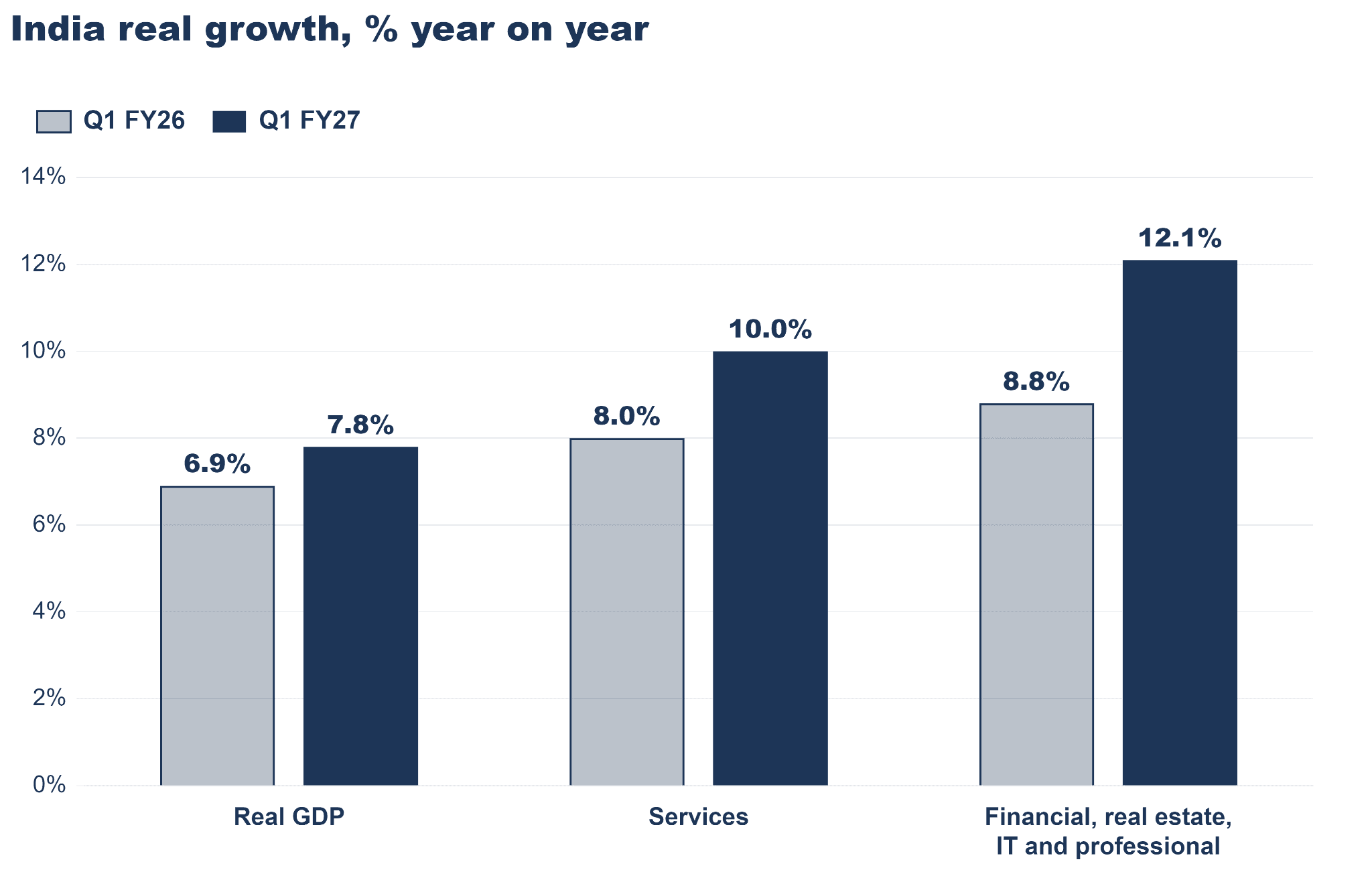
The data has since improved further. Real GDP grew 7.8% in April to June 2026, up from 6.9% a year earlier, with services up 10.0% and gross fixed capital formation up 11.9%.
First, the oil.
When Hormuz closed, Indian refiners leaned harder on Russia. Kpler data shows Russian crude arrivals hit a record 2.82 million barrels per day in July, 55.9% of India's crude imports.
Flows eased to about 2.08 million barrels per day in August and are tracking near 1.9 to 1.95 million in September. Kpler attributes the dip to refinery maintenance, Ukrainian strikes on Russian export infrastructure and Chinese competition for cargoes, not to Indian policy.
It also flags a visibility problem: India received about 640,000 barrels per day of crude of unidentified origin so far in September, against almost none in 2025, and Russian plus potentially Russian barrels still made up about 52% of arrivals. That is precisely the pattern the new law was written to punish.
Second, the trade balance.
USTR data shows US goods imports from India rose 18.9% in 2025 to $103.8 billion, while US exports to India rose 9.1% to $45.4 billion.
The goods deficit widened 27.8% to $58.4 billion. India's growth, in other words, is showing up in American import data at a time when the administration measures trade partners by their bilateral balance.
Third, the stalled deal.
The February 7 framework cut the US reciprocal rate on Indian goods to 18% and removed the 25% Russian oil penalty, in return for Indian tariff cuts and a stated intent to buy $500 billion of US goods.
Then the US Supreme Court struck down the sweeping tariffs on February 20, and the administration replaced them with a temporary 10% levy on all countries under Section 122, expiring July 24. With every competitor facing the same rate, India lost the edge the framework was meant to give it.
Commerce Minister Piyush Goyal has said India will finalise the agreement only once Washington offers a rate better than Vietnam, Bangladesh and other rivals. From Washington's side, that reads as India holding the deal hostage.
Fourth, the manufacturing shift.
Trump has been open about disliking US companies building capacity in India rather than at home. In May 2025 he recounted telling Apple's Tim Cook that the US was not interested in Apple building in India.
India's export momentum, about $317 billion across April to July against $280 billion a year earlier by Goyal's count, is partly a product of that relocation
The Macro Lens Takeaway
The US endorsement of IMEC and the Russia sanctions law are consistent. Washington wants India as the eastern anchor of a non Chinese, non Iranian trade and energy network, and it wants India's oil and tariff choices aligned with that network.
India's 7.8% growth is not under attack. Its composition is: discounted Russian crude, a $58.4 billion goods surplus with the US and a trade deal India is holding for better terms. IMEC is a decade long project.
The tariff authority is live now. Position for the near term risk, and treat the corridor as long run optionality.

