

For most of 2026 the Federal Reserve's target range sat still at 3.50 to 3.75%, the resting point after three consecutive quarter point cuts in September, October, and December of last year brought the range down from 4.25 to 4.50%.
Three holds followed, in January, March, and April, the last of these an 8 to 4 vote so divided it had not been matched since 1992.
That was also, as it turned out, Jerome Powell's final meeting as Chair. His successor, Kevin Warsh, has now had his first Jackson Hole and his first blockbuster jobs report, and both landed on the hawkish side of every published forecast.
Warsh's keynote came on Friday, August 28, the middle day of the Kansas City Fed's three day symposium at Jackson Lake Lodge, themed this year around financial innovation in payments. He told reporters ahead of the speech that his remarks were "like a blank piece of paper" and that the Fed is "not constrained by market prices," a description that turned out to undersell how directional the message actually was.
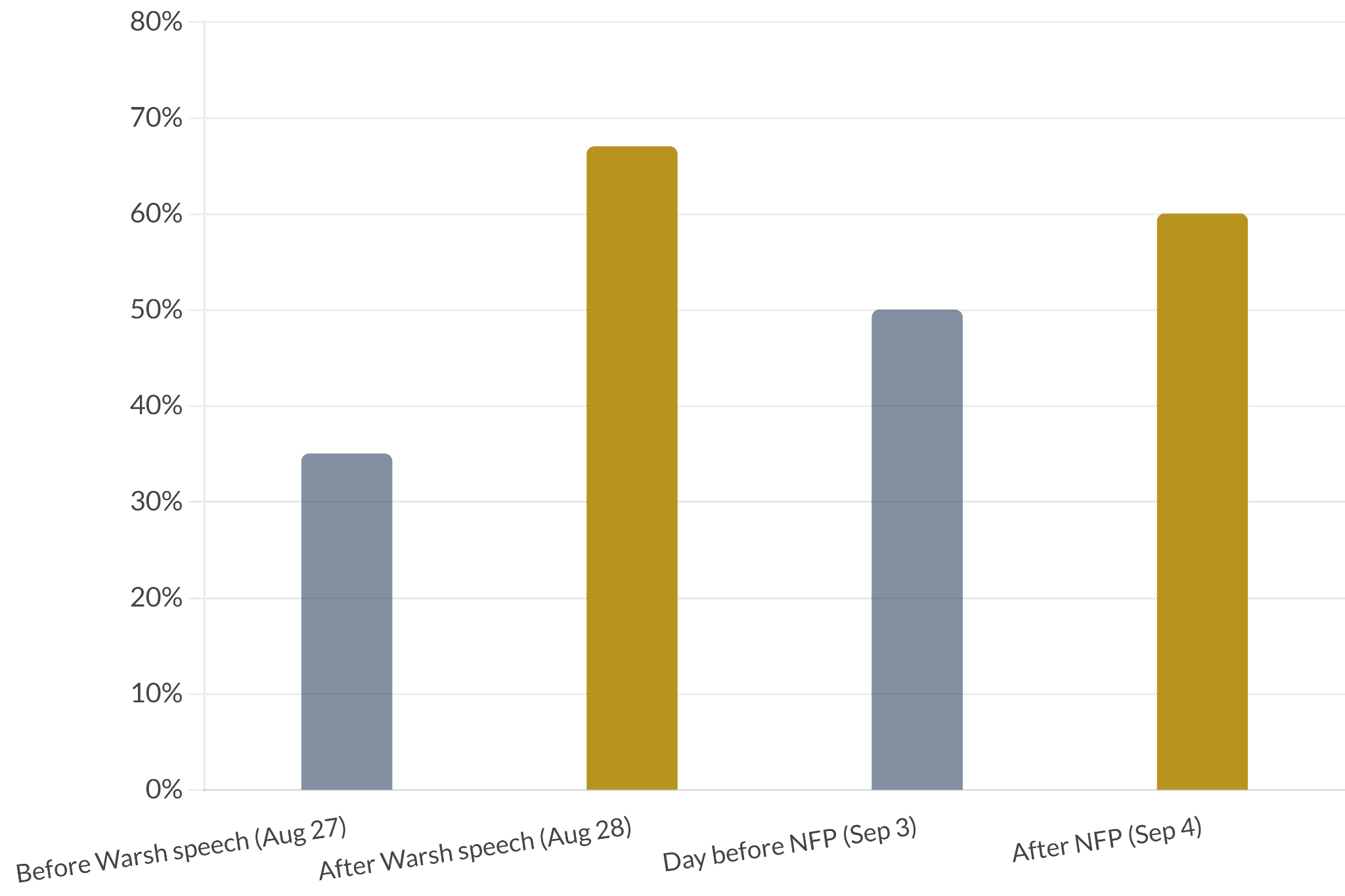
Growth remains solid, he said, the labor market is stable, and inflation is still too high; the Fed, in his words, has "work to do." Futures markets took that as confirmation rather than caution, pushing the implied probability of a September hike from roughly 35% before the speech to about 67% after it.
That was the setup. Then came the data. Friday's August payrolls report showed nonfarm employment rising by 162,000, nearly three times the Dow Jones consensus of 53,000 and the strongest monthly gain since March.
June and July were revised up by a combined 55,000, erasing what had been reported as a net job loss over those two months.
The unemployment rate held at 4.1%, below the Fed's own longer run estimate of full employment, and average hourly earnings rose 0.3% on the month to $37.75, up 3.1% year over year. Labor force participation rebounded to 61.6% from a multi year low in July.
Nearly all of the net gain, according to a widely cited breakdown of the household survey, came from women entering or returning to the workforce.
A beat of that size against consensus is not a marginal surprise; some desks flagged it as a four standard deviation miss on the forecast distribution.
The market's read was immediate and, on the surface, counterintuitive: a stronger labor market is normally good news for risk assets, but with the Fed's attention now fixed on the inflation side of its mandate rather than the employment side, a hot jobs number reads as an argument for tighter policy rather than looser.
The S&P 500 fell about 0.4%, the Dow lost roughly 0.5%, and the Nasdaq slipped 0.3% on the day. The 2 year Treasury yield, the maturity most sensitive to the near term rate path, rose to about 4.37%. Gold and bitcoin both fell as the dollar firmed.
By the close, CME and Bloomberg based measures of a September hike had climbed to somewhere between 58% and 63%, up from roughly 50% the day before the release.
Why the Reaction Function Has Flipped
The mechanical story is straightforward: a Fed that spent 2024 and 2025 cutting from restrictive territory is now sitting at a level, 3.50 to 3.75%, that Warsh and several of his colleagues apparently view as no longer clearly restrictive given a labor market that is adding jobs at a pace above its own longer run estimate of trend growth.
When growth data surprises to the upside in that environment, it no longer reads as confirmation that easing can continue; it reads as evidence that policy has room to tighten further before growth or hiring actually crack.
That is the definition of a reaction function flip, and it is the reason a beat that would have been unambiguously bullish for equities two years ago produced a selloff instead.
UBS economist Andrew Dubinsky reframed the base case entirely on the back of the print, telling clients the bank now expects two separate 25 basis point hikes, the first in September and a second in December, timed after the midterm elections, with the possibility of a pause between the two if inflation data through October cooperates.
That is a meaningfully different world from the one investors were pricing as recently as July, when the conversation was still about whether the Fed would resume cutting at all.
The July and August Consumer Price Index and Producer Price Index releases still arrive before the September 15 to 16 FOMC meeting, and several desks argue those readings, not the jobs number, will ultimately decide the outcome.
A soft core CPI print, something on the order of a 20 basis point undershoot against expectations by one estimate, could still give the doves enough cover to argue for a hold.
Absent that, the path of least resistance now runs toward a hike, something that would have seemed like a remote scenario for this Fed as recently as the spring.
The Takeaway
Markets spent the first half of 2026 pricing a Fed that was done tightening and possibly done cutting for a while.
Warsh's Jackson Hole debut and a payrolls beat that landed nearly three times consensus have together pushed September hike odds from roughly one in three to better than one in two inside two weeks.
Positioning built around a dovish or even neutral Fed into year end now carries real reassessment risk heading into the September 15 to 16 meeting, with the intervening CPI and PPI prints doing most of the remaining work.

