


UCITS mutual funds and UCITS ETFs follow the same EU rules and can hold the same assets. The difference is how you buy them and what they cost. You buy a UCITS mutual fund from the fund house or a distributor at the next net asset value (NAV) it calculates, usually once a day, often with a minimum investment and higher fees on retail share classes. A UCITS ETF trades on a stock exchange, such as the London Stock Exchange, at a live price, usually with a lower expense ratio.
This guide covers how the two differ on trading, pricing, minimums and costs, and when each one fits.
What are UCITS funds?
UCITS (Undertakings for Collective Investment in Transferable Securities) are investment funds set up under the EU's UCITS Directive. Both mutual funds and ETFs can be UCITS funds. Most are domiciled in Ireland or Luxembourg, but they can invest in assets anywhere, including US shares.
For the full definition, read what UCITS means.
What is the difference between UCITS mutual funds and UCITS ETFs?
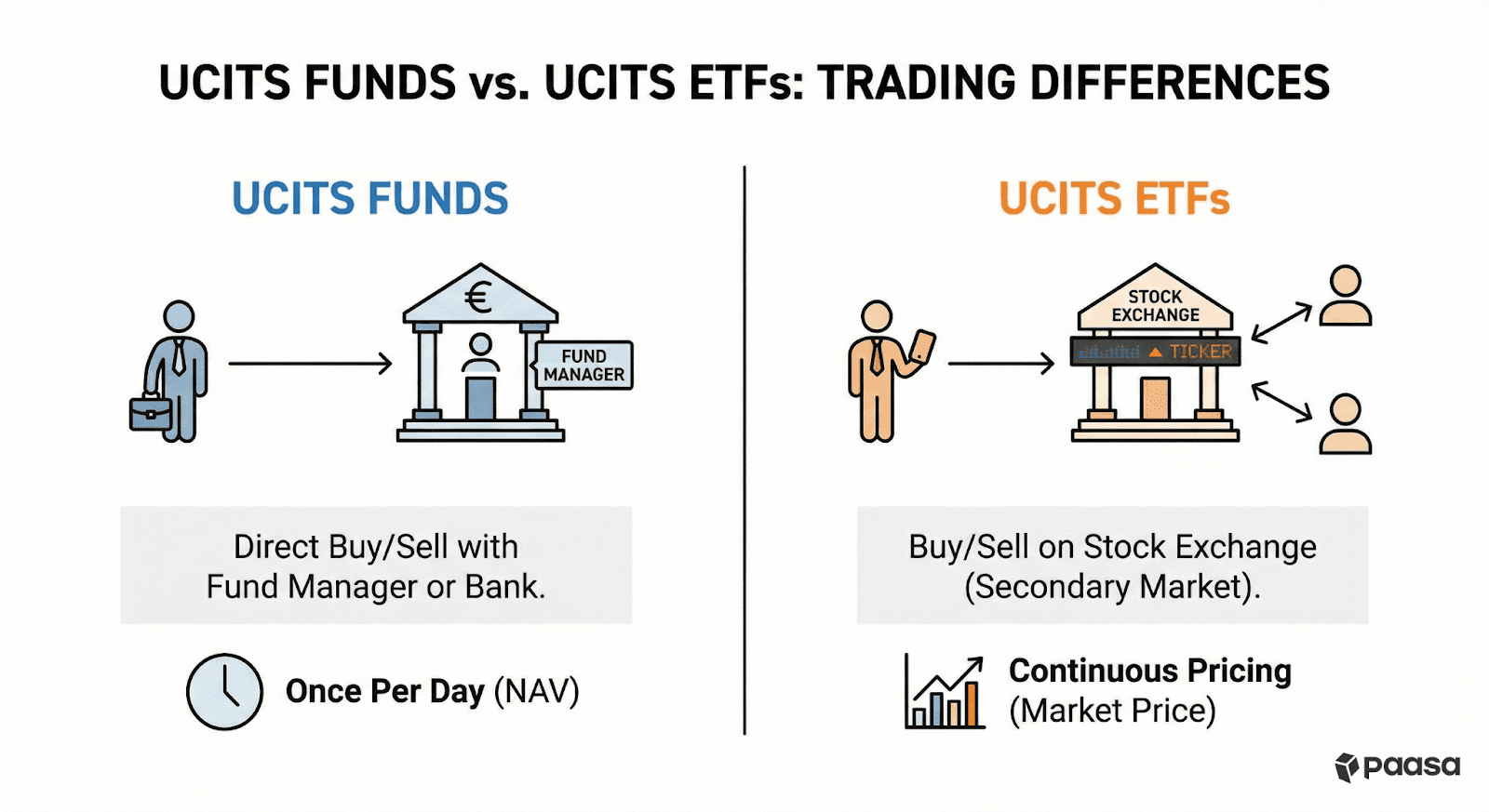
The core difference is how you buy and sell them, not what they hold.
- UCITS mutual funds: not listed on an exchange. You subscribe (buy) or redeem (sell) units through the fund manager or a distributor such as a bank or platform, at the next price the fund calculates.
- UCITS ETFs: listed on a stock exchange. You buy and sell units from other investors during market hours, like a share.
How do fees, pricing and minimums compare?
| UCITS mutual funds | UCITS ETFs | |
|---|---|---|
| How you trade | Orders are processed once a day | Traded during market hours |
| Price you get | The NAV calculated after your order (forward pricing) | The live market price when your order fills |
| Minimum investment | Often set by the fund, and higher for lower-fee share classes | Usually one unit |
| Share classes | Often several, with different fees and minimums | Usually one or a few |
| Ongoing costs | Retail share classes usually charge more | Usually lower |
| Entry and exit charges | Some funds charge them | None, you pay brokerage and the bid-ask spread |
Every UCITS fund must publish a Key Information Document (KID) that lists its ongoing charges and any entry or exit charges. Check it before you invest.
Example. The iShares Core S&P 500 UCITS ETF (CSPX), an Ireland-domiciled accumulating ETF, has a total expense ratio of 0.07%. Compare that figure with the ongoing charges in the KID of any mutual fund you are considering for the same exposure.
Is a UCITS ETF the same as a US ETF?
No. Both are exchange-traded funds, but a UCITS ETF is domiciled in Europe (usually Ireland) and a US ETF is domiciled in the US. For Indian investors, the domicile changes two things:
- Dividend withholding: under the US-Ireland tax treaty, the US generally withholds 15% on dividends paid to an Irish fund, against 25% on dividends you receive directly as an Indian resident.
- US estate tax: Irish-domiciled ETFs are not US-situs assets, so they sit outside US estate tax.
Read UCITS vs US ETFs for Indian investors for the full comparison.
When does each one fit?
1. UCITS ETFs
ETFs suit investors who want to track an index, such as the S&P 500, the Nasdaq 100 or a world index:
- Lower costs: index ETFs usually have lower ongoing charges than retail share classes of mutual funds, without high minimums.
- Accumulating options: many UCITS ETFs come in accumulating share classes, which reinvest dividends inside the fund. You have no dividend to report each year, and pay capital gains tax when you sell: 12.5% if held for more than 24 months, or your slab rate if held for 24 months or less (section 197 of the Income-tax Act 2025). See accumulating vs distributing UCITS ETFs.
- Live prices: you see the price before you trade.
Note: most ETFs track an index, so they offer less choice of active managers.
2. UCITS mutual funds
Mutual funds can suit investors who want something ETFs rarely offer:
- Active managers: some active strategies are only available as mutual funds.
- Less liquid assets: in areas like high-yield bonds or small companies, a mutual fund can close to new money to protect existing investors.
Note: retail share classes usually carry higher fees than the institutional classes of the same fund, which need much larger minimums. Compare the ongoing charges in the KID with what an ETF charges for similar exposure.
Where can you buy UCITS funds and ETFs?
To buy UCITS ETFs, you need a broker with access to European exchanges such as the London Stock Exchange. Many international investing apps in India offer only US exchanges, which limits you to US-domiciled funds.
On Paasa, you can buy both UCITS mutual funds and UCITS ETFs. Paasa gives you direct access to the London Stock Exchange, so you can buy UCITS ETFs in USD, GBP or EUR lines. Read how to buy UCITS ETFs from India for the steps.
Top UCITS ETFs
Here are some of the most popular accumulating UCITS ETFs available to Indian investors.
| Category | Ticker (LSE) | Fund name |
|---|---|---|
| S&P 500 | VUAA | Vanguard S&P 500 UCITS ETF (Acc) |
| S&P 500 | CSPX | iShares Core S&P 500 UCITS ETF (Acc) |
| Nasdaq 100 | CNX1 | iShares Nasdaq 100 UCITS ETF (Acc) |
| Nasdaq 100 | EQAC | Invesco Nasdaq-100 UCITS ETF (Acc) |
| Global equities | VWRA | Vanguard FTSE All-World UCITS ETF (Acc) |
| Developed markets | SWDA | iShares Core MSCI World UCITS ETF (Acc) |
| Emerging markets | EIMI | iShares Core MSCI EM IMI UCITS ETF (Acc) |
For more, see top UCITS ETFs for Indian investors, or compare thousands of funds with the UCITS screener.
Conclusion
UCITS mutual funds and UCITS ETFs follow the same rules and give you the same protections. The difference is in how you trade them and what they cost. ETFs trade at live prices, usually with lower charges and no minimums beyond one unit. Mutual funds trade once a day and can give access to active managers, often at higher fees. Check the KID of any fund before you invest.
About Paasa
Paasa is a global investing platform built for Indian and Asian investors, giving anyone direct access to stocks and ETFs across the US, UK, Europe and Asia.
- UCITS mutual funds and ETFs: buy UCITS mutual funds, and UCITS ETFs on the London Stock Exchange in USD, GBP or EUR lines, in the same account as your US and Asian holdings.
- Built for Indian tax rules: LRS support and India-ready tax reports for Schedule FA.
- Compare before you buy: use the UCITS screener, or start with the UCITS ETF guide.

