

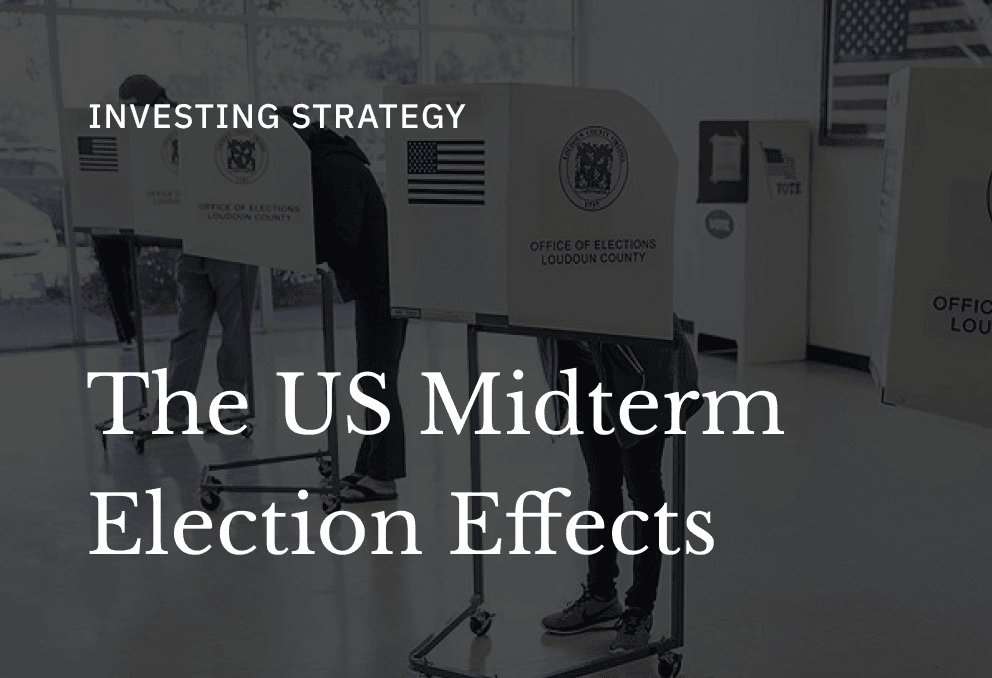
Every four years, Americans elect a president. Halfway through that term and in even numbered years that don't coincide with a presidential race, they head back to the polls for the midterm elections.
All 435 seats in the House of Representatives come up for election, along with roughly one third of the 100 Senate seats. The result can dramatically reshape the power balance in Washington, even if the president stays the same.
This political dynamic has a measurable fingerprint on financial markets. Because midterms introduce the possibility of a Congress that actively blocks the executive branch's agenda, they create a specific flavor of uncertainty, not about the economy itself, but about which laws will and won't get passed.
And markets, as they always do, price that uncertainty in advance.
The next US midterm is in November 2026, making this an important year to understand the historical playbook.

Table of contents
- The Four Year Presidential Cycle
- Before the Vote
- After the Vote
- The Gridlock Premium
- Limits of the Pattern
The Four Year Presidential Cycle
Markets don't move in a vacuum. They move in a political rhythm. The four year presidential cycle is one of the most widely studied patterns in market history, and the midterm year occupies a distinct and somewhat paradoxical position within it.

Year one of a presidency is when the new administration rolls out its agenda. The uncertainty of transition and policy implementation keeps markets cautious.
Year two, the midterm year, is historically the weakest of the cycle, characterized by elevated volatility and muted returns as investors wait to see how Congress reshuffles.
Year three, the pre election year, is consistently the strongest. Year four, the election year, is positive but uneven.
The implication is that 2026, a midterm year, lands in the weakest phase of the cycle.
Historically, the S&P 500 has averaged just around 4 to 5% in midterm years versus its long run norm of roughly 10%. But this averaged number conceals a more interesting structure: the weakness tends to concentrate in the first half of the year, followed by a pre-election rally that often continues well into year three.
Before the Vote: Uncertainty as a Drag
In the 12 months preceding midterm elections, the S&P 500 has historically delivered considerably weaker results than its long run norm.
One major US bank's analysis across 31 midterm elections since 1900 found the average pre midterm return was just 2.9%, compared to a historical average of 8.9% for all years.
The mechanism is straightforward. Investors don't know whether the president's party will retain control of Congress, lose one chamber, or lose both.
Each scenario carries materially different policy implications for taxes, spending, regulation, and trade. Until the outcome is known, capital allocation becomes tentative. Money parks in defensives and cash rather than moving into cyclical risk.
There's also a structural pattern at work: midterm years have historically seen the S&P 500 decline significantly at some point during the 12 months before the election.
Across 22 instances studied back to 1934, the average peak to trough drawdown in the midterm year was approximately 20.6%. In 2022, for context, the drawdown reached 23.6% before the June trough.
After the Vote: Clarity as a Catalyst
The post midterm rally is one of the most consistent patterns in US market history. In the 12 months following a midterm election, the S&P 500 has averaged a 16.3% return across roughly 60 years of data.
Strategas Research notes that the S&P 500 has not declined in the 12 months following a midterm election since 1946.
E*TRADE's analysis found the October to October return following each midterm since 1962 has never been negative, with an average gain of 16.3%; nearly double what markets return in non-election years.
The explanation isn't magic. When the midterm result is known, investors can recalibrate. A divided Congress limits the scope of policy change, and markets historically welcome that constraint; not because gridlock is good, but because a stable, predictable operating environment is better for earnings forecasts than an unpredictable legislative agenda.

The Gridlock Premium
One of the more counterintuitive findings in the historical data is that split government, a president of one party facing a Congress controlled partly or wholly by the other has historically coincided with above average market returns.
Standard and Poor's data shows markets have typically performed best when power is divided between Republicans and Democrats.
When one party controls the White House and both chambers, sweeping policy changes become easier to pass.
This creates a wider range of potential outcomes for companies; new tax regimes, major regulatory shifts, large spending programs. The uncertainty of "what might change" is itself a valuation headwind. When power is split and gridlock is likely, the policy environment becomes more legible. Companies can plan; investors can model earnings.
Limits of the Pattern
A pattern observed across 31 elections over 125 years is statistically fragile. When US Bank researchers applied a t-test to compare midterm years with all other years, the difference in pre midterm returns was not statistically significant.
The sample is simply too small, and the dispersion too wide, to treat the historical averages as reliable forecasts.
More practically: the Fed, corporate earnings, and macroeconomic conditions dwarf electoral signals as market drivers. In 2022, inflation running at 40 year highs and the most aggressive rate hiking cycle in decades made midterm politics a secondary concern for most of the year.
The post election rally still showed up, but the timing and magnitude were shaped far more by monetary policy than by the vote count.
The midterm effect is best understood as a useful lens rather than a trading rule. It explains why markets tend to be noisier and more tentative in even numbered years, and why the clarity of a resolved election often releases pent up capital into risk assets.
But it doesn't override the fundamentals and investors who treat it as a reliable timer will eventually be caught out by a year when the macro dominates.

