


If you are an Indian professional or businessperson who currently holds the Resident but Not Ordinarily Resident (RNOR) status and have foreign rental income, you might be confused about how India classifies and taxes this income.
This blog covers all you need to know about how India classifies foreign rental income for RNORs, when it is not taxed, and when it can be taxed by Indian authorities.
Table of contents
- Who is RNOR?
- What is foreign rental income?
- Is foreign rental income taxed in India?
- Can India classify it as income controlled from India?
- Foreign rental income after RNOR
Who is considered RNOR?
To qualify as Resident but Not Ordinarily Resident, you must first be considered a "Resident" of India for the current year.
Once you are a Resident, you fall into the special RNOR category if you meet ANY ONE of the following criteria:
- You were a Non-Resident (NRI) in at least 9 out of the 10 financial years immediately preceding the current year.
- You were physically present in India for 729 days or less in total during the 7 financial years immediately preceding the current year.
- If you are an Indian Citizen or Person of Indian Origin (PIO) with Indian income exceeding ₹15 Lakhs, you become an RNOR if you stay in India for 120 to 181 days (instead of the usual 182).
- If you are an Indian Citizen with Indian income exceeding ₹15 Lakhs and you are not liable to tax in any other country, you are automatically treated as a "Deemed Resident" in India. Deemed Residents are always classified as RNORs.
How long does it last?
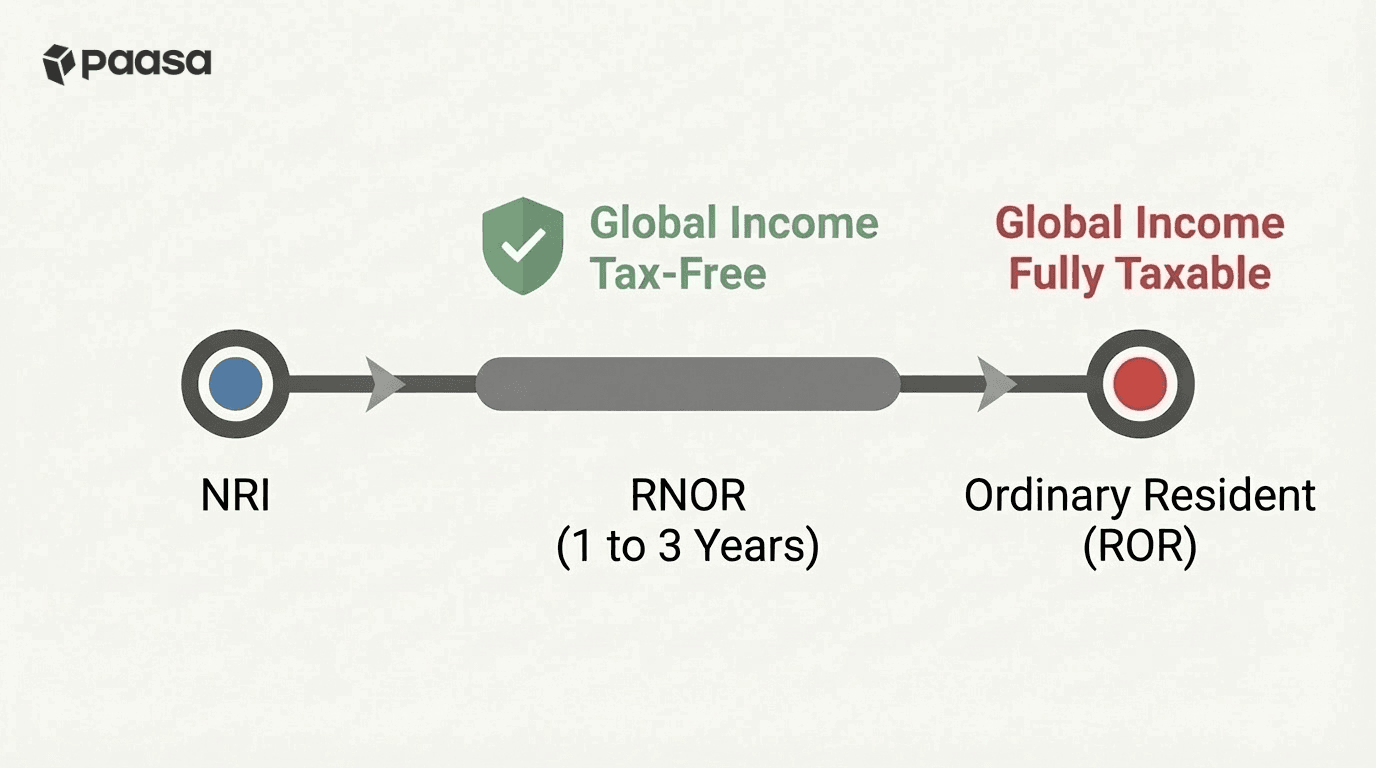
RNOR status usually lasts two or three financial years after you return, depending on when in the year you arrive and how many days you spent in India before the move.
Once this period ends, you become an Ordinary Resident (ROR), and your global income becomes fully taxable in India.
For how to count the years from your arrival date, read our guide to RNOR status.
What is considered foreign rental income in India?
If you have property located outside India generating rental income, the rent it generates is considered foreign income.
The classification depends entirely on the physical location of the asset, regardless of your citizenship or the currency of payment.
Examples
- Foreign Rental Income: You own a condo in Singapore or an apartment in the US. The rent is foreign income because the property is outside India.
- Indian Rental Income: You own a flat in Gurgaon and rent it to a US expat. This is Indian income because the property is inside India.
Is foreign rental income taxed in India when I am an RNOR?
For an RNOR, rental income from a property located outside India is tax-free in India.
This is because the Indian government considers this as income that "accrues or arises outside India." Since you are not a full Ordinary Resident yet, India does not claim a right to tax your global earnings, provided they are not derived from a business you control from India.
However, to keep this income tax-free, you must be careful about where you receive the money.
Receive it abroad first
To ensure the exemption, your tenant must deposit the rent into your foreign bank account (e.g., in the US, UK, or Singapore). Once the money hits your foreign account, the "income" is considered to have been received outside India.
After it is credited to your foreign account, you are free to transfer (remit) that money to your Indian bank account. This remittance is just a transfer of your own funds and is not taxable.
Read tax on repatriation of foreign income to India for how the transfer works.
Do not receive it directly in India
If your tenant transfers the rent directly to your Indian bank account, it is treated as "income received in India." In this case, the exemption is lost, and the entire amount becomes fully taxable in India at your slab rate, even though the property is abroad and you are an RNOR.
Can there be a situation where India classifies it as income controlled from India and taxed accordingly?
The "business controlled from India" rule generally does not apply to rental income.
Here is why: Under Indian tax laws, income is classified into specific "heads." The "business controlled from India" clause applies only to income that falls under the head "Profits and Gains of Business or Profession."
Rental income falls under a completely different head: "Income from House Property."
Because your rental income is classified as "Property Income" and not "Business Income," the question of where it is controlled is legally irrelevant. Even if you sit in Mumbai and approve tenants or authorize repairs for your London flat, it remains "Property Income" and remains tax-free for an RNOR.
Exception
The only situation where this could be taxed is if your rental activity is so extensive that the Tax Department reclassifies it as a business.
Example:
You don't just own one house; you own 20 serviced apartments in Dubai. You have a team, you run daily operations, and you manage this entire commercial enterprise from your office in India.
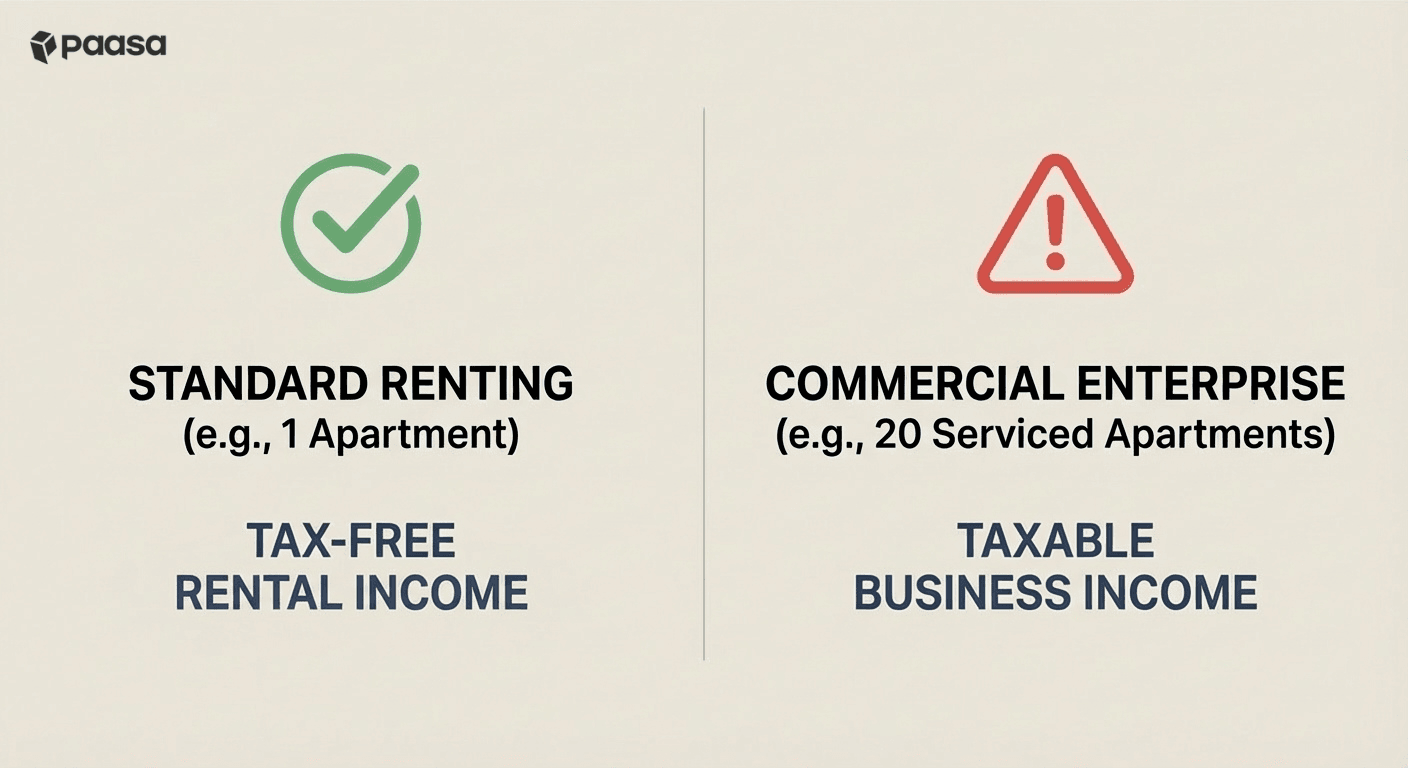
In this specific case, the tax department could argue that you are not earning "rent" but running a "hotel business." If they reclassify your income as "Business Income," then the "Controlled from India" rule kicks in, and you would have to pay tax in India.
How is foreign rental income taxed once I become ROR?
Once you are ROR, India taxes rent from a property abroad as income from house property, wherever you receive it. You get a standard deduction of 30% of the rent after local property taxes and a deduction for interest on the loan, and the balance is taxed at your slab rate.
The country where the property is located usually taxes the rent as well. India then gives you a foreign tax credit for that tax, up to the Indian tax on the same income, which you claim by filing Form 44 (earlier Form 67). You also report the property in Schedule FA every year from your first ROR year.
Our country guides cover what the other country charges on rent after you leave, for Australia, the UK and Singapore.
About Paasa
Paasa is a global investing platform for Indian residents and NRIs, including those who have just moved back.
- Keep your foreign portfolio: hold stocks and ETFs across the US, UK, Europe and Asia from one account after you return, without having to sell.
- Move your holdings in kind: transfer an existing portfolio from your overseas broker, so the move itself is not a sale.
- Reports for your Indian return: year-end reports for Schedule FA, capital gains and dividend income, ready to share with your CA.

