

For Indian investors buying UCITS ETFs, the two most common domicile options are Ireland and Luxembourg.
While both offer access to the same global markets, the fund's domicile can affect taxes, costs, regulation, and overall investment efficiency.
In this blog, we'll compare Ireland and Luxembourg UCITS ETFs, explore the advantages and disadvantages of each domicile, and help you decide which one is better suited for your portfolio.
Table of content
- Does ETF Domicile Actually Matter?
- Ireland vs Luxembourg UCITS: What's the Difference?
- The Advantages and Disadvantages of Each Domicile
- Which Domicile Should Indian Investors Choose?
- About Paasa
Does the Domicile of an UCITS ETF Matter for Indian Investors?
When investing in UCITS ETFs, Indian investors will typically encounter two dominant fund domiciles: Ireland and Luxembourg.
While both provide access to the same global markets and investment opportunities, a fund's domicile can influence several factors that ultimately affect investor returns.
Although domicile does not change the underlying assets held by the ETF, it can impact:
- Dividend withholding taxes
- Fund costs and expenses (TER)
- Regulatory oversight
- Fund availability and product choice
Small differences in taxes and costs may seem insignificant, but they can compound over time and meaningfully affect long-term returns.
Ireland vs Luxembourg UCITS: What’s the Difference?
Although both jurisdictions operate under the UCITS framework, Ireland and Luxembourg have evolved into leading fund domiciles with distinct characteristics. The key differences between the two are outlined below:
| Factor | Ireland UCITS | Luxembourg UCITS |
|---|---|---|
| US dividend tax | 15% withholding on US dividends. | 30% withholding on US dividends. |
| Fund costs / TER | Usually lower fund cost due to less corporate tax. | Slightly higher fund cost. |
| Regulation / ESMA | More literal and standardised approach in ETF rules. | More flexible interpretation in some cases. |
| US Estate tax | No US estate-tax exposure like US-domiciled ETFs. | No US estate-tax exposure like US-domiciled ETFs. |
| Fund availability | Broader ETF universe, especially US-equity ETFs. | Good range, but fewer dominant US-equity ETFs. |
The Advantages and Disadvantages of Each Domicile
Ireland generally offers lower costs and better tax efficiency for mainstream equity ETFs, while Luxembourg's strength lies in fund structuring flexibility and specialised investment strategies.
Ireland-Domiciled UCITS ETFs
Advantages
- Ideal for US and global equity exposure. Ireland is the largest UCITS ETF domicile in Europe and is home to many of the world's most popular S&P 500, Nasdaq-100, and global index ETFs.
- More tax-efficient for US investments. Under the US-Ireland tax treaty, Irish-domiciled ETFs face only a 15% withholding tax on dividends from US stocks, improving long-term returns for investors.
- Lower costs. Ireland's large ETF ecosystem supports greater scale, which often translates into lower expense ratios, tighter trading spreads, and a wider choice of funds.
Disadvantage
- Fewer niche fund options. Some specialised, actively managed, or complex strategies are only available through Luxembourg-domiciled structures.
Luxembourg-Domiciled UCITS ETFs
Advantages
- Well-suited for specialised strategies. Luxembourg is widely used for active ETFs, thematic funds, alternative strategies, and more bespoke investment structures.
- Greater structuring flexibility. The domicile allows fund managers to launch ETF share classes within existing UCITS funds and, in some cases, convert mutual funds into ETFs, making product launches more efficient.
- Extensive product universe. Investors can access a broad range of funds and strategies that are not available through Irish structures.
Disadvantage
- Higher costs and lower tax efficiency. Luxembourg-domiciled ETFs investing heavily in US equities suffer a higher US dividend withholding tax drag and carry slightly higher expense ratios compared with equivalent Irish ETFs.
Note that both Ireland and Luxembourg domiciled UCITS protect you from the US Estate Tax. To learn more, read our guide on How the US Estate Tax Works for Indians and what assets are subject to it.
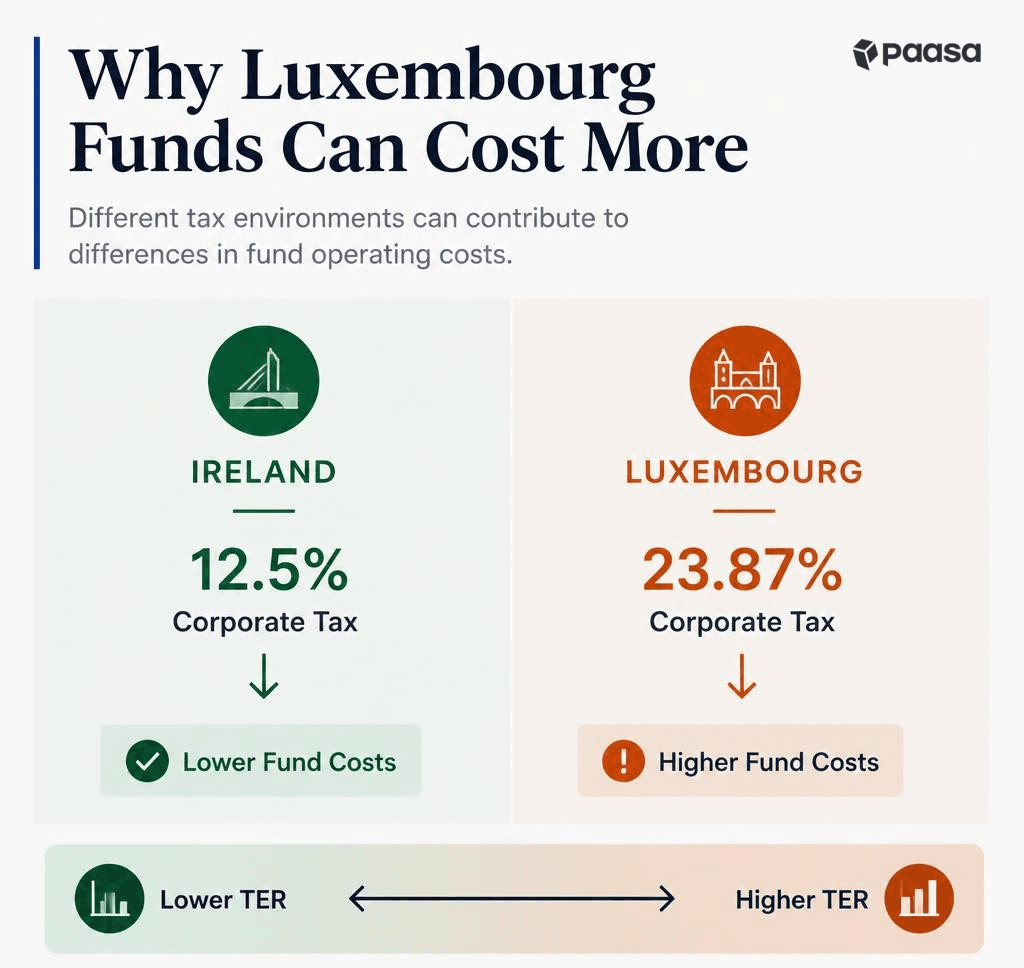
Why Luxembourg Funds Can Cost More
Luxembourg can sometimes have a higher operating cost burden than Ireland. One reason is the difference in corporate tax rates - 23.87% in Luxembourg versus 12.5% in Ireland.
Although these taxes are not charged directly to investors, they can contribute to higher fund operating costs and, in some cases, slightly higher TERs.
Which Domicile Should Indian Investors Choose?
For Indian investors buying US or global equity ETFs, Ireland is the better default because it combines better dividend tax efficiency, broader fund choice, and lower net costs.
Luxembourg is still worth considering if the fund is niche, if US dividend exposure is low, or if the specific ETF you want only exists there. In that case, compare the actual TER, tracking difference, and index exposure before deciding.
About Paasa
Paasa helps Indian investors access global markets with ease, enabling investments across the US, Europe, China, Japan, and other major economies. Trusted by HNIs, family offices, and institutions, it combines international investing opportunities with India-focused support and compliance.
What makes Paasa different is its investor-first compliance infrastructure:
- Built-in FEMA and LRS compliance for every transaction.
- Comprehensive tax reporting tailored for Indian investors, including capital gains, dividend taxation, and TCS tracking.
- Dedicated support for remittances, fund transfers, reconciliations, and regulatory queries.
From global equities and ETFs to UCITS funds, managed portfolios, and estate-tax-efficient structures for RSU holders, Paasa offers a seamless platform for building international portfolios while helping investors stay compliant with Indian regulations.

