

If you receive RSUs as part of your compensation from companies like Amazon, Microsoft, or Google, understanding how they're taxed is important.
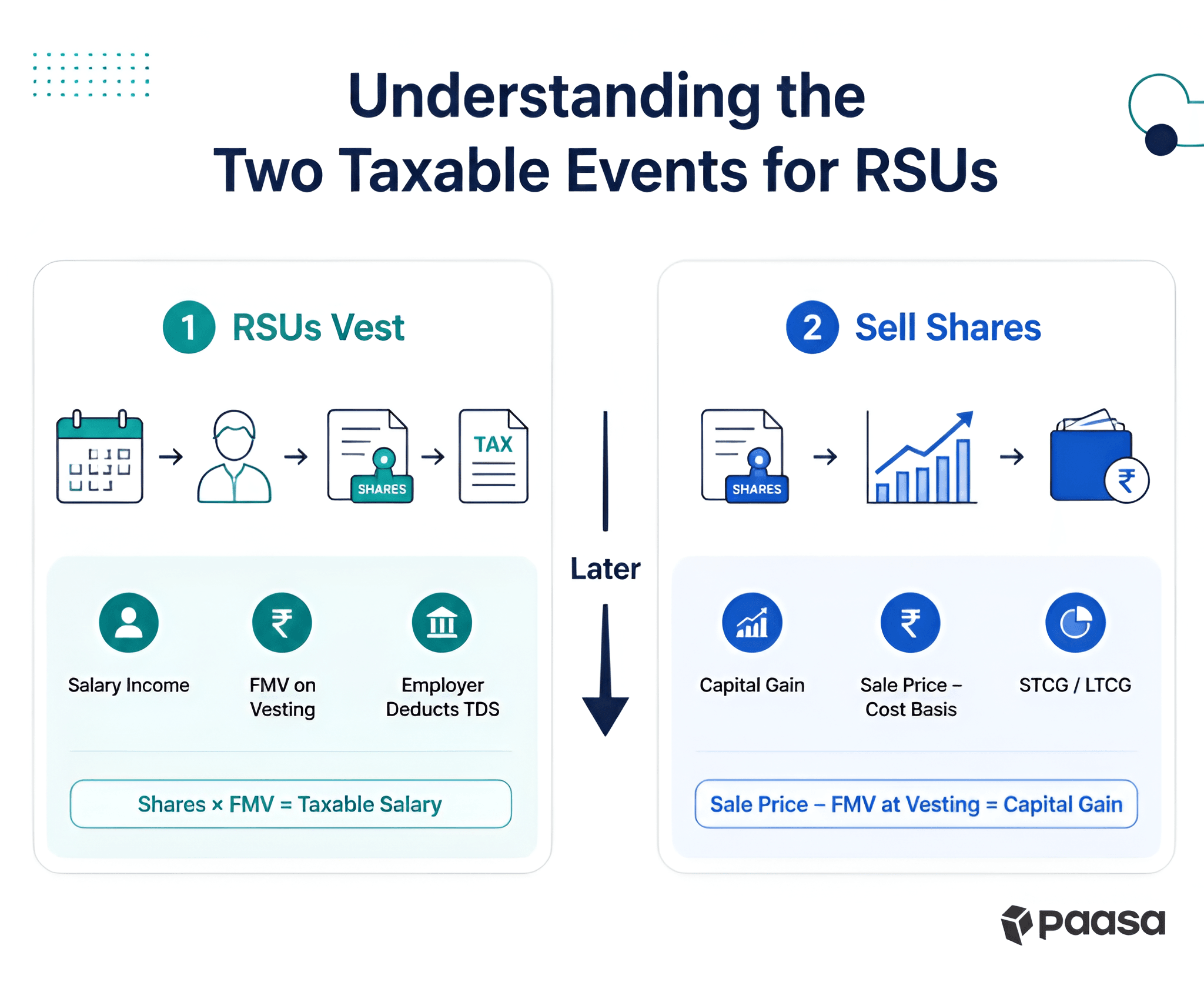
RSUs are taxed twice, first as salary income when they vest, and again as capital gains when you sell the shares.
This guide walks you through the complete RSU tax lifecycle, explaining how taxes are calculated at vesting and at sale, how your cost of acquisition is determined, and how each step affects your final tax liability.
Table of contents:
- Understanding the Two Taxable Events for RSUs
- How to Calculate Salary Income at Vesting
- How to calculate when you sell
- How to Calculate Taxes When You Have Multiple RSU Vesting Lots
- Common Mistakes When Calculating RSU Taxes
Understanding the Two Taxable Events for RSUs
Before calculating your taxes, it's important to understand that RSUs are taxed at two different stages. Each stage has its own tax treatment and calculation.
Tax Event 1: When Your RSUs Vest
Your employer grants RSUs before you actually own them. You become the legal owner of the shares only when they vest.
On the vesting date, the fair market value (FMV) of the vested shares is treated as a perquisite, which forms part of your salary income.
The FMV is converted into INR using the SBI Telegraphic Transfer (TT) Buying Rate, applicable on the vesting date. The resulting amount is taxed according to your applicable income tax slab, just like your regular salary.
In India, this amount is taxed according to your applicable income tax slab, just like your regular salary.
Taxable Value (INR) = Number of Vested Shares × FMV per Share (USD) × SBI TT Buying Rate (USD/INR)
Your employer deducts TDS under Section 192 before you receive the shares, either by selling a portion of the shares (sell-to-cover) or deducting it from salary.
Tax Event 2: When You Sell Your RSUs
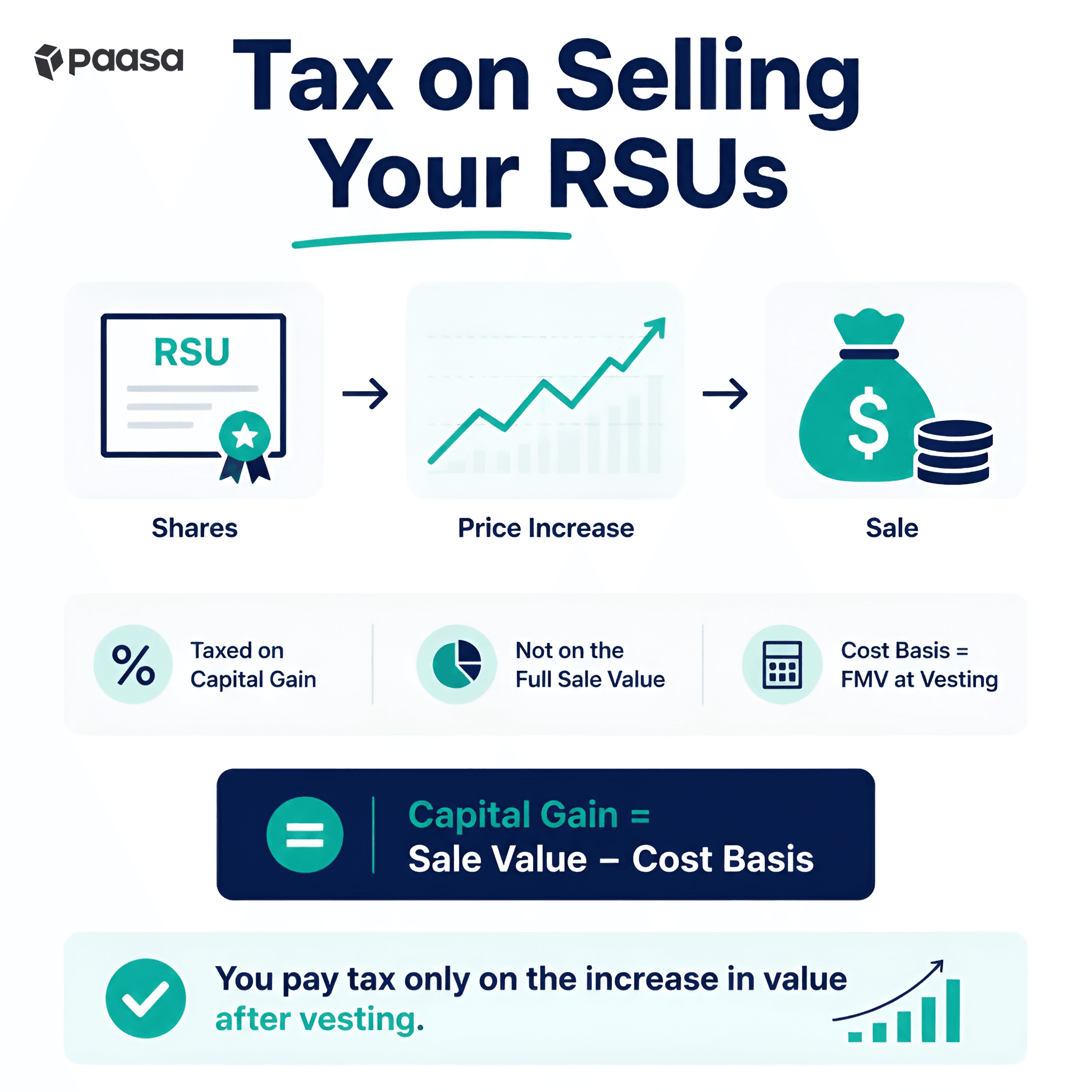
When you sell your vested RSUs, you only pay capital gains tax on the increase in the share price after vesting.
This is because the fair market value (FMV) of the shares on the vesting date was already taxed as salary income.
That FMV converted into INR using the applicable exchange rate becomes the cost of acquisition for Indian tax purposes.
As a result,
Capital Gain = Sale Value − Cost of Acquisition (FMV on the Vesting Date)
What is the cost of acquisition for calculating gains in case of RSUs?
The cost of acquisition for RSUs is the Fair Market Value (FMV) of the shares on the vesting date - the same value that was taxed as salary.
Example:
Suppose your RSUs vested when they were worth $1000 per share. You paid income tax on ₹100 because it was treated as part of your salary.
As a result, the cost of acquisition of your shares is also $1000 per share. If you later sell the shares for $1500, your capital gain is $500 ($1500 − $1000).
You pay capital gains tax only on this $500 gain.
Whether the gain is treated as short-term or long-term depends on how long you held the shares after vesting.
How to Calculate Salary Income at Vesting
The first tax event happens when your RSUs vest. At this point, the fair market value (FMV) of the vested shares is treated as part of your salary and added to your income.
You have to pay tax on this amount in the year the vesting happens, whether you keep the shares or sell them right away.
To calculate your taxable salary income, you'll need:
- Number of vested shares.
- Fair Market Value (FMV) on the vesting date: The market price of one share on the date your RSUs vested.
- Exchange rate applicable on the vesting date: Since your shares are priced in a foreign currency, the FMV must be converted into Indian Rupees (INR) using the SBI TT Buying Rate on the vesting date,
Salary Income = Number of Vested Shares × FMV on Vesting Date × Exchange Rate
Example
Suppose you have 100 RSUs that vest on 1 April 2025. On the vesting date, the FMV is $500 per share, and the SBI TT Buying Rate is ₹85.6 per USD.
Your taxable salary income would be:
100 × $500 × ₹85.6 = ₹42,80,000
In this case, ₹42,80,000 is treated as part of your salary income for the year and is taxed according to your applicable income tax slab.
Calculate the Tax Payable at Vesting
Since the value of vested RSUs is treated as salary, it is taxed at your applicable income tax slab. In addition to the slab rate, surcharge (if applicable) and Health & Education Cess are also payable.
Estimated Tax = Taxable Salary Income × Tax Rate
Example
Suppose you earn more than ₹1 crore and hence fall in the 30% income tax slab. Continuing from previous example:
| Component | Rate | Amount |
|---|---|---|
| Taxable salary income from RSUs | ₹42,80,000 | |
| Income tax | 30% | ₹12,84,000 |
| Surcharge | As applicable (10%) | ₹1,28,400 |
| Health & Education Cess | 4% on income tax + Surcharge | ₹56,496 |
| Total Tax | ₹14,68,896 |
How Is This Tax Paid?
Unlike capital gains tax, you don't have to calculate and pay this tax yourself.
Employers usually deduct Tax Deducted at Source (TDS) under Section 192 of the Income-tax Act when your RSUs vest. This is usually done in one of two ways:
- Sell-to-cover: The employer or broker automatically sells enough shares to cover the tax liability and credits you with the remaining shares.
- Tax deducted from salary: Instead of selling shares, the tax is deducted from your salary.
The TDS deducted on your vested RSUs is reflected in your Form 16 and can be claimed while filing your Income Tax Return.
To understand how RSUs appear in your Form 16 and how to verify the details, read our guide on How to Read Form 16 if You Receive RSUs.
How to Calculate Tax When You Sell Your RSUs
When you sell your vested RSUs, you have to pay capital gains tax.
To calculate your taxable gain, you first need to determine your sale value, identify the correct cost of acquisition, and then calculate the difference between the two.
The following steps explain how to calculate your capital gain accurately.
Step 1: Calculate Your Cost of Acquisition
Once your RSUs vest, the FMV on the vesting date becomes the cost of acquisition of your shares.
Cost of Acquisition = Number of Shares × FMV on Vesting Date × Exchange Rate on Vesting Date
This is the same value you calculated as your taxable salary income in Step 1: ₹42,80,000
Why Is the Cost of Acquisition Important?
Using the correct cost of acquisition ensures that you are taxed only on the correct increase in value after your RSUs vest.
Step 2: Calculate Your Capital Gains When You Sell
When you sell your RSUs, the sale itself becomes the second taxable event.
You only pay tax on the capital gains on the share price after vesting.
Capital Gain = Sale Value (INR) − Cost of Acquisition (INR)
Where:
Sale Value = Number of Shares Sold × Sale Price × Exchange Rate on Sale Date
Step 3: Calculate the Tax on Your Capital Gains
Once you've calculated your capital gain, the next step is to determine the applicable tax rate. This depends on how long you held the shares after they vested.
For foreign company shares received as RSUs, the holding period is counted from the vesting date to the sale date.
| Holding period from vest date | Classification | Tax rate |
|---|---|---|
| Up to 24 months | Short-term capital gains (STCG) | At your income slab rate |
| More than 24 months | Long-term capital gains (LTCG) | 12.5%, without indexation |
To learn more, read our detailed guide on Capital Gains Tax on RSU Shares.
How to Calculate Taxes When You Have Multiple RSU Vesting Lots
Most employees don't receive all of their RSUs in a single vesting. Instead, RSUs vest over several months or years.
Each vesting creates a separate vesting lot, and every lot must be tracked independently for tax purposes.
This is because each vesting lot has a different vesting date, number of shares, Fair Market Value (FMV), cost of acquisition, holding period and exchange rate (the SBI TT Buying Rate used at vesting).
When you eventually sell your shares, you cannot combine all your RSUs into a single calculation.
Instead, you need to calculate the capital gain for each vesting lot separately and then add them together to determine your total capital gain.
Example:
Suppose your RSUs vested in three different lots:
| Vesting Date | Shares | FMV (USD) | Exchange Rate | Cost of Acquisition (INR) |
|---|---|---|---|---|
| 1 April 2025 | 100 | $500 | ₹85.60 | ₹42,80,000 |
| 1 October 2025 | 100 | $550 | ₹88.7 | ₹48,78,500 |
| 1 April 2026 | 100 | $600 | ₹92.64 | ₹55,58,400 |
If you later sell all 300 shares together, you should:
- Calculate the sale value attributable to each vesting lot.
- Subtract the respective cost of acquisition for each lot.
- Determine whether each lot qualifies as STCG or LTCG based on its own holding period.
- Calculate the tax separately for each lot before arriving at your total tax liability.
Common Mistakes When Calculating RSU Taxes
Calculating RSU taxes involves multiple dates, exchange rates, and tax rules, so it's easy to make mistakes. Here are some of the most common errors to avoid.
Using the Grant Price Instead of the Vesting FMV
Your grant price has no impact on your taxes. The taxable value at vesting and your cost of acquisition are both determined using the Fair Market Value (FMV) on the vesting date, not the grant date.
Using the Wrong Exchange Rate
RSUs are usually priced in a foreign currency, but your taxes are calculated in INR. Using an incorrect exchange rate can lead to an incorrect salary value, cost of acquisition, and capital gain.
For salary income at vesting, employers use the SBI TT Buying Rate.
Forgetting That Withheld Shares Were Also Taxed
If your employer uses a sell-to-cover arrangement, some shares are automatically sold to pay the tax due at vesting.
A common misconception is that only the shares you receive were taxed. In reality, all vested shares, including those sold to cover taxes, are treated as salary income at vesting.
Combining Multiple Vesting Lots
Combining different vesting lots into a single calculation can result in incorrect capital gains and the wrong tax treatment.
Using the Sale Price as the Cost of Acquisition
Your cost of acquisition is the FMV on the vesting date, not the price at which you sell the shares. Using the sale price as the cost of acquisition can significantly understate or overstate your capital gains.
Calculating Gains Only in USD
Many taxpayers calculate gains by comparing purchase and sale prices in USD, but Indian taxes are calculated in INR.
Because exchange rates change between vesting and sale, convert both cost of acquisition and sale value to INR using the applicable rates before calculating capital gains.
How Paasa Can Help
Paasa helps Indian investors and RSU holders access global markets with ease, enabling investments across the US, Europe, China, Japan, and other major economies.
Trusted by HNIs, family offices, and institutions, Paasa combines international investing opportunities with India-focused support and compliance.
Paasa helps you hold and protect your RSU wealth with:
- In-kind transfer from your existing brokerage account
- Access to US, Europe, China, Japan, and other major economies
- Access to UCITS ETFs that protect against the US estate tax risk
- Comprehensive tax reporting tailored for Indian investors, including capital gains, dividend taxation, and TCS tracking.

