


Indian investors holding US stocks or ETFs directly incur a 25% dividend withholding tax ( under the India-U.S. DTAA).
However, Ireland-domiciled UCITS ETFs only incur a 15% fund-level dividend withholding tax on dividends from US and ETFs. And this tax is deducted at the fund level, not from the investor directly.
The investor does not have to deal with a dividend withholding tax as Ireland does not charge withholding tax from foreign investors.
In this guide, we'll explain how the 15% treaty rate works, how it is applied inside an ETF, and what investors should know when comparing Ireland-domiciled and US-domiciled funds.
Table of content
- What is dividend withholding tax?
- Why do Ireland-Domiciled ETFs pay only 15% US withholding tax?
- Does the 15% treaty benefit apply to non-US equity ETFs?
- Ireland-Domiciled ETFs vs US-Domiciled ETFs
- Common misconceptions
- About Paasa
What Is Dividend Withholding Tax?
Dividend withholding tax is a tax deducted from dividends before they are received by an investor (an individual investor or a fund).
For ETFs, this tax is typically applied at the fund level.
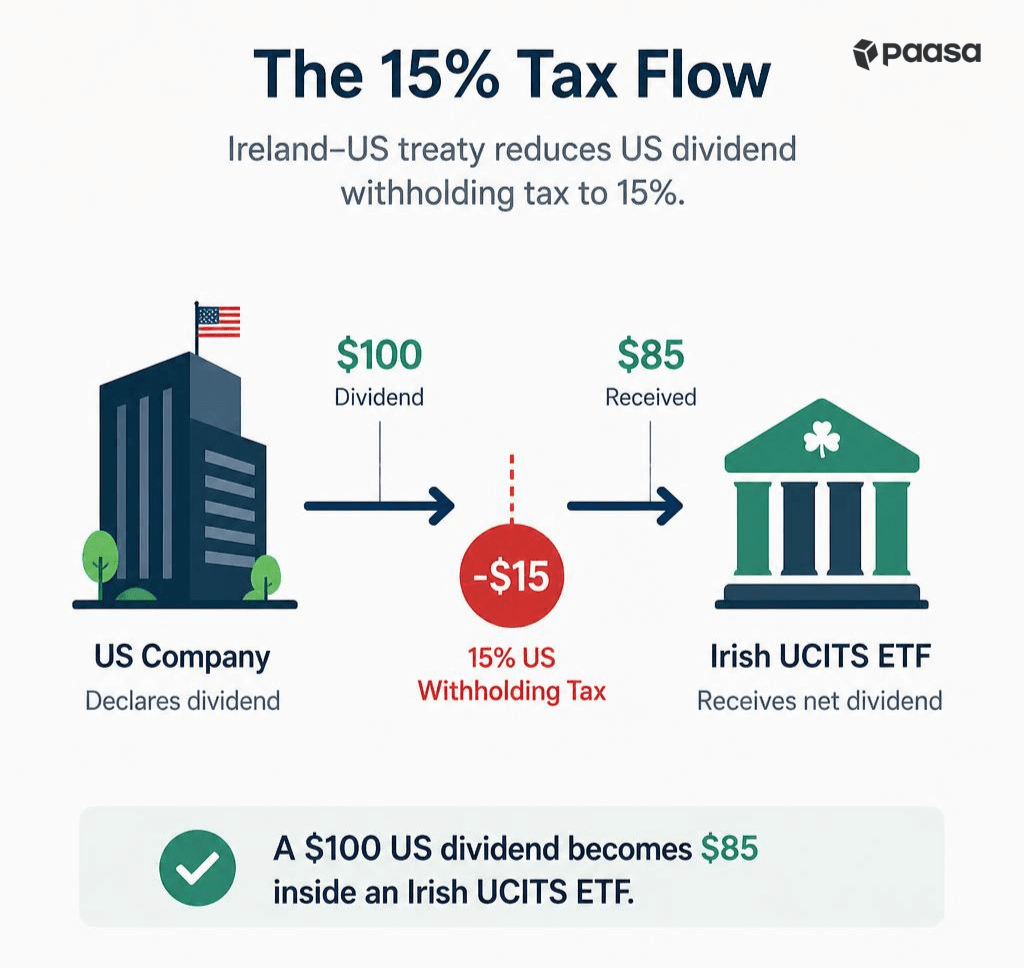
For example, an Ireland-domiciled ETF investing in US stocks is subject to a 15% US withholding tax on dividends received from US companies under the US-Ireland tax treaty.
As a result, if the underlying stocks generate $100 in dividends, the ETF receives $85 after withholding tax.
Why Do Ireland-Domiciled ETFs Pay Only 15% US Withholding Tax?
How the Ireland-US Tax Treaty Creates This 15% Rate
The 1997 United States-Ireland Income Tax Treaty reduces the standard U.S. dividend withholding tax rate from 30% to 15% for qualifying Irish residents.
Ireland-domiciled UCITS ETFs are treated as Irish tax residents for treaty purposes, which allows them to benefit from the reduced 15% U.S. withholding tax rate on dividends from U.S. companies.
The total tax liability for Irish UCITS ETFs on this US dividend income is also 15%, which is paid in form of this withholding tax.
How the 15% Withholding Tax Is Applied Inside the ETF
When an Ireland-domiciled ETF receives dividends from U.S. stocks, the withholding tax is deducted before the cash reaches the fund.
So if the underlying U.S. holdings generate dividend income, the ETF receives only the amount left after the 15% tax has been withheld at source.
Ireland does not charge any withholding tax on distributions from Irish UCITS ETFs to non-Irish investors. So, the end investor does not have to deal directly with any dividend withholding tax.
Does the 15% Treaty Benefit Apply to Global and Non-US Equity ETFs?
If an ETF holds stocks from multiple countries, the 15% treaty rate applies only to dividends paid by U.S. companies.
Dividends from companies in other countries are taxed under those countries’ own withholding rules and treaties, which vary by market.
As a result, a global ETF’s effective withholding tax rate is a blend of different tax regimes rather than a flat 15%.
Ireland-Domiciled ETFs vs US-Domiciled ETFs: Tax Comparison
For Indian investors seeking exposure to US equities, the choice is often between a US-domiciled ETF and an Ireland-domiciled UCITS ETF.
While both may hold the same underlying stocks, their tax treatment can be very different.
| Aspect | US-Domiciled ETF | Ireland-Domiciled UCITS ETF |
|---|---|---|
| US Dividend Withholding Tax | 25% as per the India-US DTAA | 15% at the fund level under the Ireland-US treaty |
| US Estate Tax Exposure | Applies above USD 60,000 of US-situs assets | No US estate tax exposure on the ETF itself |
| Accumulating Share Classes | Unavailable | Available |
| Dividend Tax Events | Dividends are typically paid out to investors | Dividends can be automatically reinvested through accumulating structures |
Common Misconceptions About Ireland-Domiciled ETF Withholding Tax
Ireland-domiciled ETFs do not pay any US withholding tax.
Not quite. The Ireland-US tax treaty reduces the fund-level withholding tax on US dividends to 15%, but it does not eliminate it.
The 15% rate applies to all dividends received by the ETF.
No. The treaty benefit applies to dividends from US companies. Dividends from other countries are subject to their own withholding tax rules and treaty networks.
Accumulating ETFs avoid withholding tax because they do not distribute dividends.
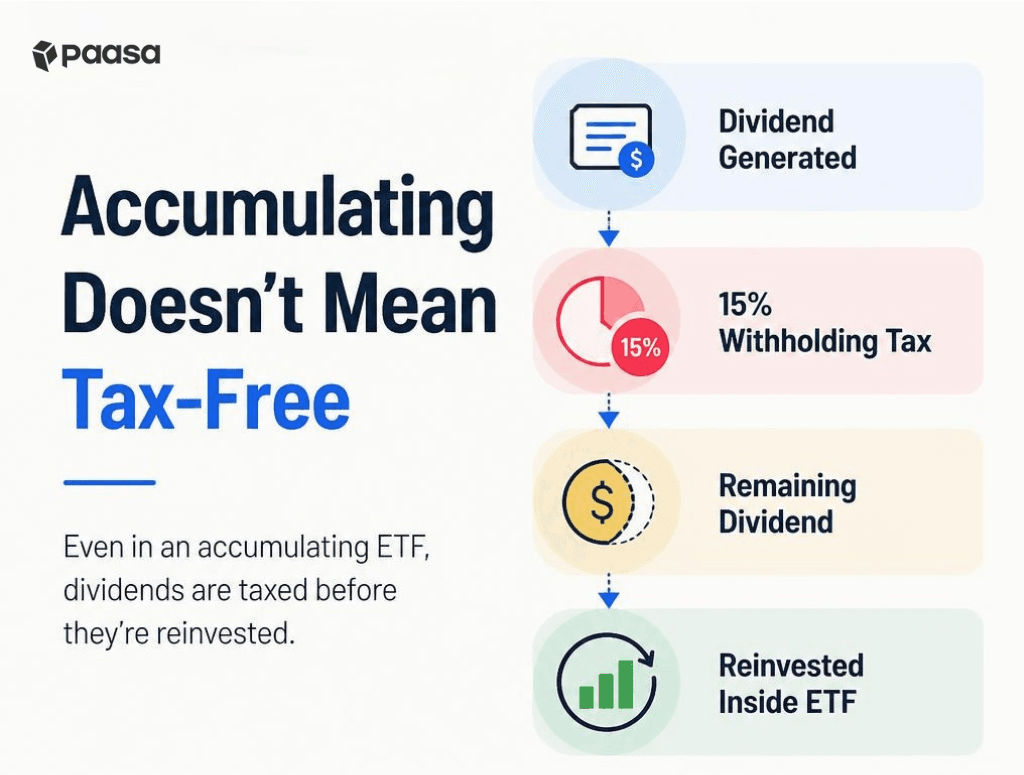
Accumulating ETFs still receive dividends from the underlying companies they hold. The withholding tax is deducted before those dividends are reinvested inside the fund.
Investors can reclaim the 15% withholding tax from the IRS.
No. The withholding tax is deducted at the ETF level before the dividend reaches investors, so investors cannot reclaim it directly from the IRS.
The 15% treaty benefit guarantees higher returns.
The treaty reduces dividend tax leakage, but overall returns will still depend on market performance, fees, and the ETF's investment strategy.
About Paasa
Paasa is an Indian investor’s gateway to global investing, trusted by HNIs, family offices, and institutions to diversify into markets across the US, Europe, China, Japan, and beyond.
What sets Paasa apart is its India-facing compliance layer:
- FEMA and LRS compliance embedded into every transaction.
- Tax reporting and analytics built for Indian investors (LTCG, STCG, dividend tax, TCS tracking).
- End-to-end support for remittance structuring, reconciliation, and compliance queries.
Whether it’s equities, ETFs, UCITS funds, managed strategies, or even helping you protect your RSUs from estate tax, Paasa provides a single transparent platform for global portfolios with the confidence that India-specific compliance is taken care of.

