

Receiving RSUs from your employer means your shares are held with the brokerage selected for your company's stock plan. This may not suit you if you change jobs, move back to India, or want to consolidate investments.
Vested RSUs can be transferred to another eligible broker without selling them, allowing you to keep the same shares while managing them elsewhere.
This guide covers which RSUs can be transferred, who can receive them, how the process works, and what happens after the transfer.
Table of content
- Can I Transfer My RSUs to Another Broker?
- Which RSUs Are Eligible for Transfer?
- Who Can Receive Your RSUs?
- How Can I Transfer My RSUs?
- What Happens to Your Cost Basis and Holding Period?
- Will I Owe Tax on an RSU Transfer?
- Reasons Your RSU Transfer May Fail
- How Paasa Can Help
- Frequently Asked Questions
Can I Transfer My RSUs to Another Broker?
Yes you can, but only after your RSUs have vested.
Once your RSUs vest, they become ordinary shares that you legally own. You can then freely transfer them to any broker that supports US-listed investments.
Most broker-to-broker transfers are completed electronically through the Automated Customer Account Transfer Service (ACATS) or another transfer system supported by the brokers involved.
Which RSUs Are Eligible for Transfer?
Whether you can transfer your RSUs depends entirely on their vesting status.
Vested RSUs
Once your RSUs vest, they become shares that you own. Once these shares are deposited into your brokerage account, they can be transferred to another eligible broker.
Unvested RSUs
Unvested RSUs cannot be transferred because they are not yet shares, they're simply a promise from your employer to grant shares in the future if you satisfy the vesting conditions.
Since you don't own the shares yet, there is nothing that can be transferred. You'll need to wait until the RSUs vest before moving them to another brokerage account.
Who Can Receive Your RSUs?
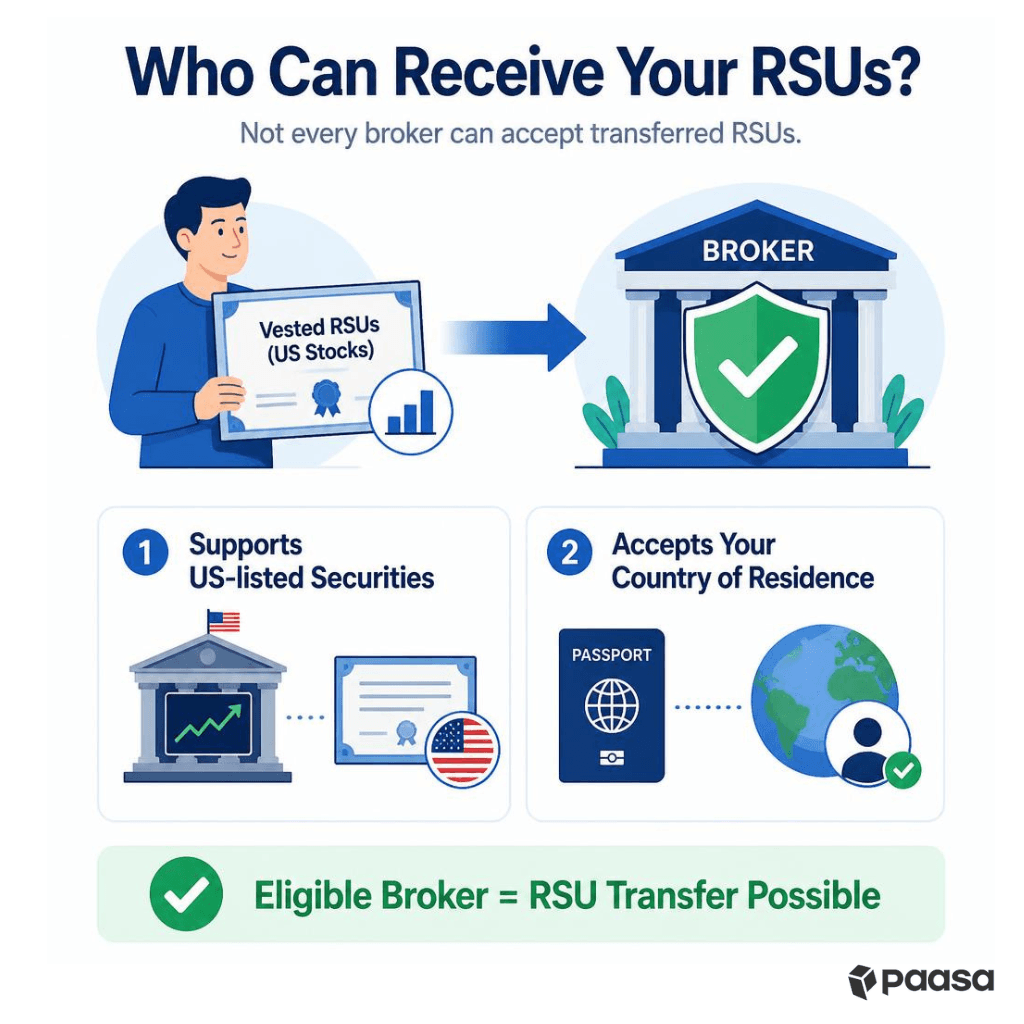
Not every broker account can receive transferred RSUs.
Since vested RSUs are US-listed shares, the receiving broker must satisfy two requirements:
- It must be able to hold US-listed securities.
It must allow you to maintain an account based on your country of residence.
US brokers that accept incoming transfers
Most major US brokerages support transfers of eligible US-listed securities.
If your shares are currently held with brokers such as Charles Schwab, Fidelity, Morgan Stanley at Work or E*TRADE, you can transfer vested shares to another participating broker through the standard ACATS transfer process.
Brokers that support Indian residents
Not every US brokerage accepts Indian residents as clients.
Before initiating a transfer, confirm that the receiving broker allows Indian residents to maintain brokerage accounts and continue holding US-listed securities.
Eligibility requirements of the receiving broker
Before submitting a transfer request, confirm that the receiving broker:
- Accepts transfers of US-listed securities.
- Allows Indian residents (or residents of your country) to hold brokerage accounts.
- Supports transfers from your current broker.
- Can receive your specific account or security type.
Checking these details beforehand can help avoid delays or rejected transfer requests.
How Can I Transfer My RSUs?
If both brokers support the Automated Customer Account Transfer Service (ACATS), the transfer is completed electronically without selling your shares.
Most major brokers support ACATS. If you're transferring to Paasa, you can initiate the process in the app, and our team will handle the coordination and documentation.
While the exact process can differ based on your employer's stock plan and the brokers involved, most transfers follow a similar workflow.
For a detailed explanation of the ACATS transfer process, read our guide on How ACATS Works for Indian Investors.
Step 1: Open an account with the receiving broker
Before initiating the transfer, you'll need an account with the broker that will receive your shares. To avoid delays, ensure the account is opened in the same legal name as your existing brokerage account.
Step 2: Submit the transfer request
In most cases, the receiving broker initiates the transfer on your behalf. You'll be asked to provide:
- Your existing brokerage account number
- The name of your current broker
- Details of the shares being transferred
If you're transferring your RSUs to Paasa, simply complete the sign-up process in the Paasa app and follow the in-app transfer guide for your current broker.
Once the request is submitted, our team coordinates with your existing broker and handles the documentation required to complete the transfer.
Step 3: Validation and transfer
Your current broker reviews the request to confirm that the account information matches and that the shares are eligible for transfer.
Once validated, the eligible shares are transferred in-kind to your new brokerage account without being sold.
How long does it take?
Transfers completed through ACATS are typically finished within 5-7 business days, although employer stock plan restrictions, account mismatches, or unsupported assets can extend the timeline.
What Happens to Your Cost Basis and Holding Period?
Transferring RSUs to another broker doesn't create a new investment, only the custodian changes.
Does your cost basis transfer?
Yes. Your original cost basis details move with the shares. This information is used to calculate your capital gains when you eventually sell the shares.
It may take a few weeks for this information to appear in your new account, so download your records before initiating the transfer.
Does your holding period reset?
No. A transfer isn't a sale, so your original acquisition date remains unchanged and your holding period continues uninterrupted.
Will I Owe Tax on an RSU Transfer?
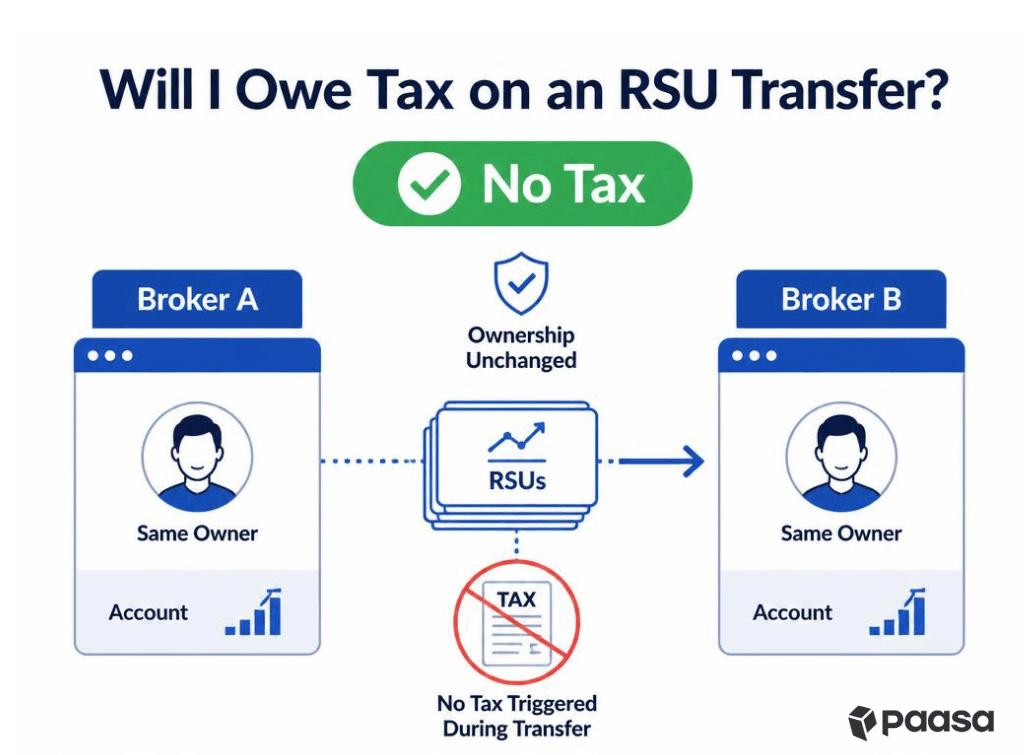
No. A broker-to-broker transfer is not a taxable event.
You're simply moving shares from one brokerage account to another while remaining the owner. Since there's no sale or change in ownership, the transfer itself doesn't trigger capital gains tax.
Tax only comes into play when you eventually sell the shares.
Reasons Your RSU Transfer May Fail
Although most transfers are straightforward, there are situations where a transfer request may be delayed or rejected.
Company trading blackouts
Many companies restrict transactions involving employee shares during designated blackout periods.
If a transfer request is submitted during one of these periods, you will need to wait until the restriction is lifted.
Account ownership mismatches
The sending and receiving brokerage accounts need to be registered in the same legal name.
Even small differences in account ownership can cause delays or require additional documentation.
Broker-specific restrictions
Some brokers only accept transfers from certain institutions or may not support particular account types.
It's always a good idea to confirm your receiving broker's transfer policies before beginning the process.
How Paasa Can Help
Paasa helps Indian investors and RSU holders access global markets with ease, enabling investments across the US, Europe, China, Japan, and other major economies.
Trusted by HNIs, family offices, and institutions, Paasa combines international investing opportunities with India-focused support and compliance.
Paasa helps you hold and protect your RSU wealth with:
- In-kind transfer from your existing brokerage account
- Access to US, Europe, China, Japan, and other major economies
- Access to UCITS ETFs that protect against the US estate tax risk
- Comprehensive tax reporting tailored for Indian investors, including capital gains, dividend taxation, and TCS tracking.

