

If you are a returning NRI in your RNOR period with RSUs vesting from a previous employer abroad, the tax treatment of those vesting depends on your residency status when they vest.
This article covers how India treats RSU vesting income during the RNOR window, how to calculate the taxable portion, and what happens to future capital gains once the shares vest.
Table of Contents
- Are RSU vesting events taxable during your RNOR period?
- How is the taxable portion of my RSU vesting calculated?
- Further Reading
- About Paasa
Are RSU vesting events taxable during your RNOR period?
It depends on where you rendered your services during the vesting period.
During your RNOR window, India does not tax your foreign-sourced income. So the portion of your RSU vesting income that was earned while you were working abroad is classified as foreign-source income and is not taxable in India.
However, RSU vesting income is not entirely foreign just because the company is based abroad. If your vesting period straddles your time abroad and your time back in India, the income is split between the two countries based on the workdays you spent in each. The India-source portion is fully taxable in India as salary income, regardless of your RNOR status.
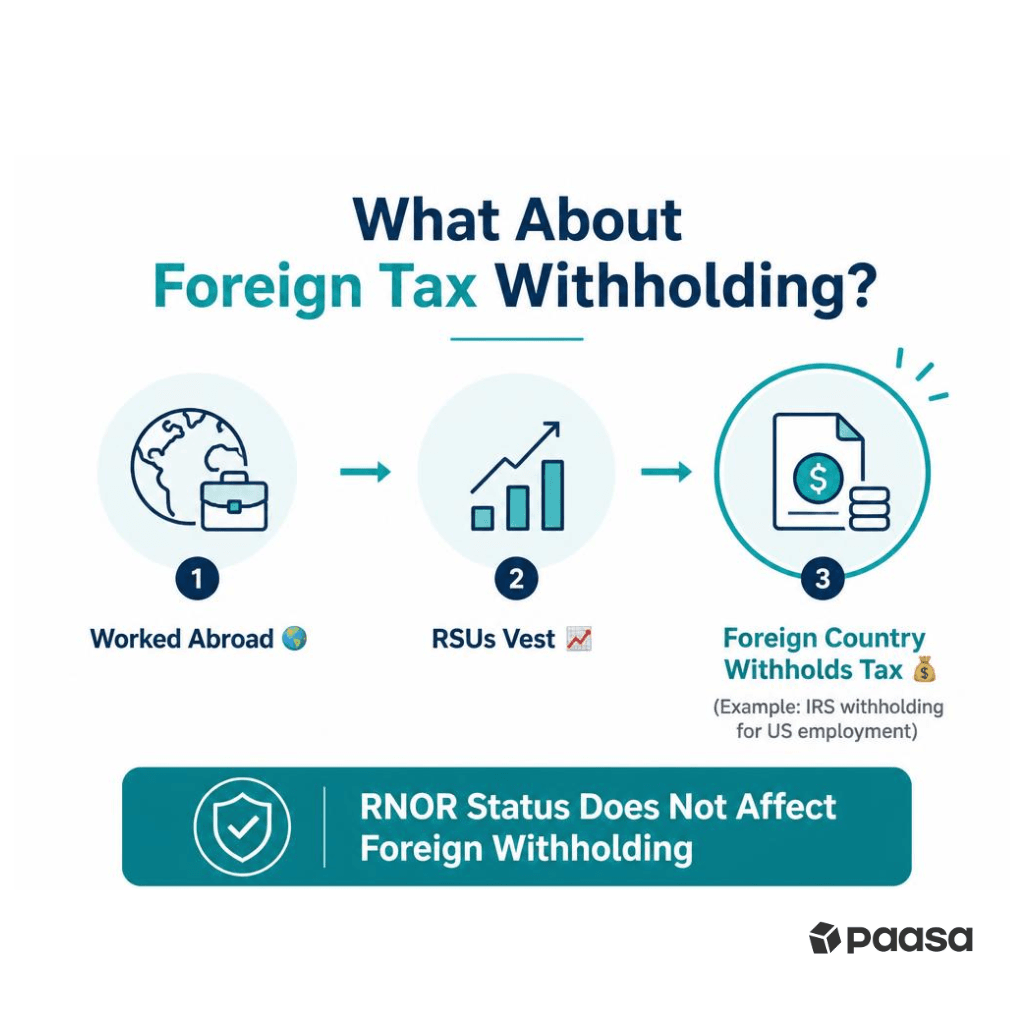
What about foreign tax withholding?
Even though the foreign-source portion is exempt in India, the country where you worked may still withhold tax on their portion at the time of vesting. For example, if you worked in the US, the IRS treats RSU vesting as ordinary income and subjects it to US withholding regardless of where you currently live. This is a separate obligation from your Indian tax liability and is not affected by your RNOR status.
How is the taxable portion of my RSU vesting calculated?
The vesting income is apportioned based on the number of workdays you spent in India versus abroad across the entire vesting period.
Example
Suppose you were granted RSUs over a 4-year vesting period. You spent 3 years working in the US and returned to India 1 year before the RSUs fully vested. At the time of vesting, the RSUs are worth Rs. 40 lakhs.
| Workdays | Proportion | Vesting Income | |
|---|---|---|---|
| US (Foreign-source) | 1,095 days | 75% | Rs. 30 lakhs |
| India-source | 365 days | 25% | Rs. 10 lakhs |
| Total | 1,460 days | 100% | Rs. 40 lakhs |
The Rs. 30 lakhs attributable to your US workdays is foreign-source income and is not taxable in India during your RNOR period. The Rs. 10 lakhs attributable to your India workdays is taxable as salary income at your applicable slab rate.
Note: Your employer may not always apportion this correctly in your payslip. It is worth verifying the breakdown with your HR or payroll team, and consulting a qualified tax advisor to ensure the correct amount is being reported.
What happens to future capital gains?
Once your RSUs vest, your cost basis for those shares becomes their fair market value at the time of vesting. Any gains from selling those shares in the future are calculated from this cost basis, not the original grant price.
If you are still in your RNOR period when you sell, and you are no longer a tax resident of the country where you worked, those capital gains may not be taxable in either country. For a full breakdown of how to make the most of this, read our guide on how RNORs can reset their cost basis.
Common questions
My entire vesting period was spent abroad before I returned to India. Is the full vesting income tax-free in India?
Yes. If all your workdays during the vesting period were rendered outside India, the entire vesting income is classified as foreign-source income and is not taxable in India during your RNOR period.
My employer has already withheld tax in the US on my vesting. Do I still need to report it in India?
The foreign-source portion is exempt from Indian tax when you hold the RNOR status, so there is no Indian tax liability to offset the US withholding against. You will need to deal with the US withholding separately through your US tax filing. Consult a tax advisor familiar with cross-border RSU taxation for your specific situation.
Does the RNOR exemption apply if the vesting proceeds are credited directly to my Indian bank account?
No. The exemption applies only to income received outside India. If the vesting proceeds are credited directly to an Indian bank account, they are treated as income received in India and become fully taxable, regardless of your RNOR status.
Further Reading
Understanding RNOR
- Resident vs RNOR vs Non-Resident: What is the Difference?
- How Returning NRIs (RNOR) Should Structure Equity and RSUs
- Do RNORs Need to Fill Schedule FA?
Returning to India: Country-Specific Guides
- A Guide for NRIs Returning to India from the US
- A Guide for NRIs Returning to India from the UAE
- A Guide for NRIs Returning to India from Singapore
- A Guide for NRIs Returning to India from the UK
- A Guide for NRIs Returning to India from Canada
- A Guide for NRIs Returning to India from Germany
- A Guide for NRIs Returning to India from Australia
About Paasa
Paasa is a global investing platform built for Indian residents and returning NRIs. If you have RSUs vesting during your RNOR period, this is one of the most valuable windows in your financial life to restructure your equity and significantly reduce your future tax liability.
- Hold and trade globally through your RNOR period: Access 10+ exchanges including the US, UK, Germany, Singapore, and Hong Kong, all from a single account held in your name at Interactive Brokers.
- Seamless in-kind transfers: Move your existing US portfolio from Schwab, Fidelity, Robinhood, or E*TRADE to Paasa without triggering a taxable event, so you stay invested through the transition.

